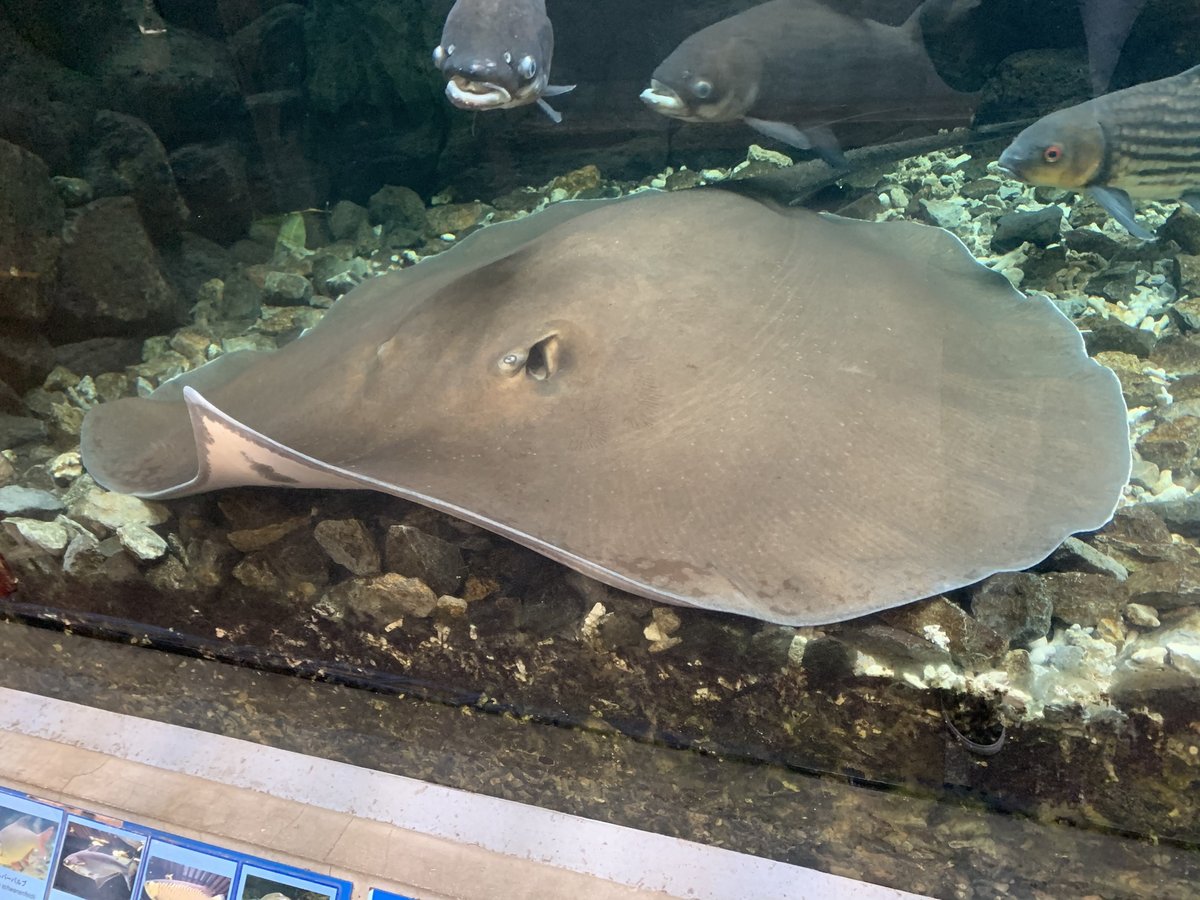
Giant Freshwater Stingray
Urogymnus polylepis
- Diet
- Bottom-dwelling small fishes and invertebrates.
- Range
- Large rivers and associated estuaries in mainland Southeast Asia and Borneo.
- Habitat
- Bottom-dwelling in large rivers and estuaries, especially over sandy or muddy areas.
- Activity
- Bottom-dwelling; individuals may feed along the edge of rivers.
- Reproduction
- Viviparous: embryos develop first using yolk and later receive histotroph, or “uterine milk,” from the mother. Litters contain one to four pups, and newborns measure around 30 cm across.
- Conservation
- Endangered overall under the IUCN assessment cited for 2021; Critically Endangered in Thailand.
- Defenses
- Its serrated tail spine can reach 38 cm long—the largest reported for any stingray species. The spine sits near the base of the thin, whip-like tail.
- Sensing the world
- Ampullae of Lorenzini—specialized organs that detect weak electrical signals—help this ray locate small fishes and invertebrates in the river bottom.
- Raising the next generation
- Females give birth to live young in litters of one to four. During development, the embryos are later nourished by histotroph, a nutrient-rich fluid sometimes called “uterine milk.”
- What to notice
- The ray is broad and plain grayish brown above, but its white underside has wide dark bands along the rear edges of the pectoral and pelvic fins—useful markings to notice when it turns.
- Look closer
- A specimen recorded from the Mekong in 2022 weighed 300 kg and measured 3.98 m long and 2.2 m wide, setting a record for the largest documented strictly freshwater fish.
Facts
- Its serrated tail spine can reach 38 cm long—the largest reported for any stingray species. The spine sits near the base of the thin, whip-like tail.
- Ampullae of Lorenzini—specialized organs that detect weak electrical signals—help this ray locate small fishes and invertebrates in the river bottom.
- Females give birth to live young in litters of one to four. During development, the embryos are later nourished by histotroph, a nutrient-rich fluid sometimes called “uterine milk.”
- The ray is broad and plain grayish brown above, but its white underside has wide dark bands along the rear edges of the pectoral and pelvic fins—useful markings to notice when it turns.
- A specimen recorded from the Mekong in 2022 weighed 300 kg and measured 3.98 m long and 2.2 m wide, setting a record for the largest documented strictly freshwater fish.
Print and study the Giant Freshwater Stingray
This species is included in: