Thornback Ray
Raja clavata
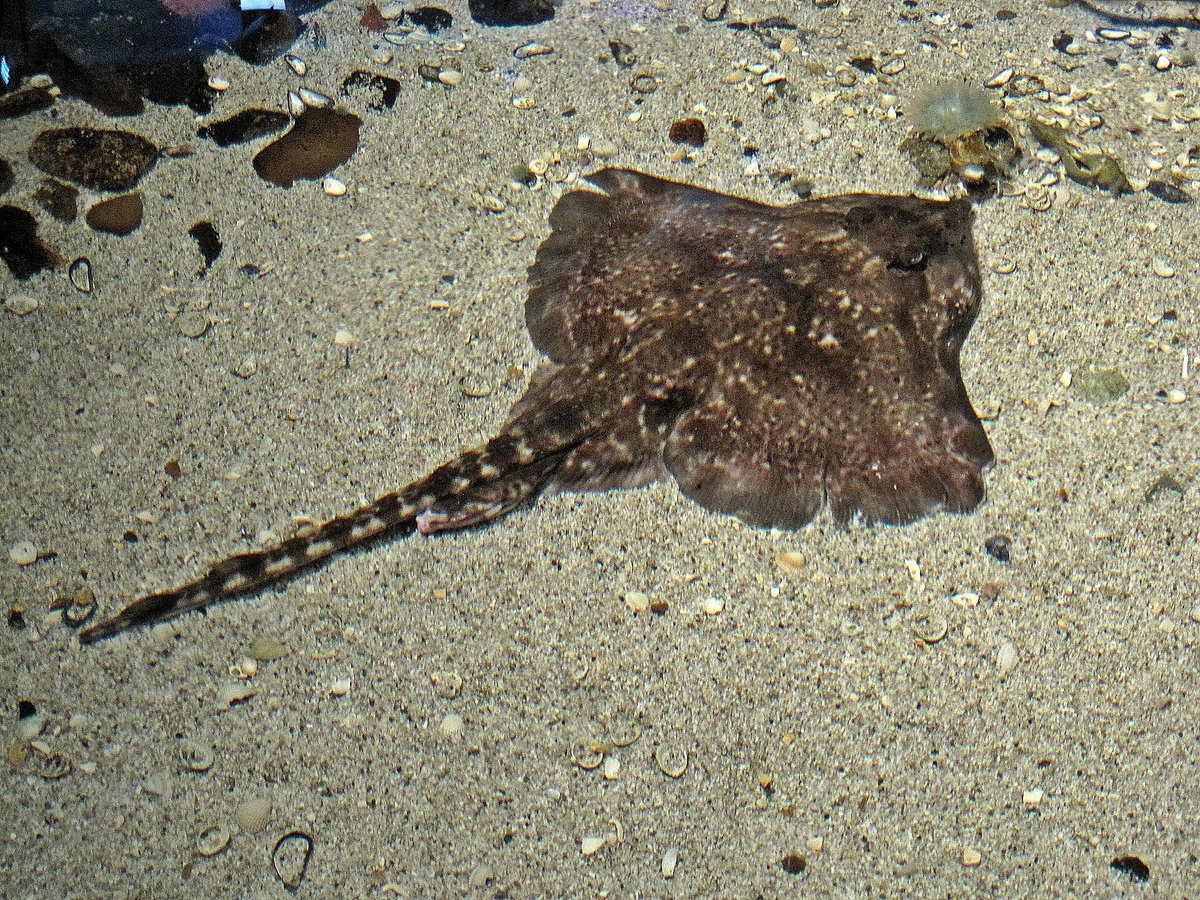
- Diet
- Juveniles eat small crustaceans, especially amphipods and bottom-living shrimps; adults eat crabs, shrimps and small fish.
- Range
- Atlantic coastal waters of Europe and western Africa, extending through the Mediterranean and Black Seas and from South Africa to the southwestern Indian Ocean; native range is stated as possibly extending south to Namibia and South Africa.
- Habitat
- Usually found on mud, sand or gravel seabeds from inshore waters to deeper areas; it also occurs in open and shallow seas and may become trapped in large estuarine pools at low tide.
- Lifespan
- Maximum known age: 15 years; sexual maturity is reported at 7–8 years.
- Activity
- A demersal species associated with the sea floor, found from inshore waters to recorded depths of 300 m and, less frequently, 1,020 m.
- Reproduction
- Oviparous and polyandrous. Females deposit paired egg cases on shallow sand, mud, pebble or gravel bottoms; the capsules contain one embryo, which develops by feeding on yolk, and hatch after about 4–5 months.
- Life cycles
- Its egg case is an oblong capsule with stiff pointed horns at the corners. Each case holds one embryo and is anchored to the bottom with an adhesive film.
- Defenses
- Adult females can carry numerous thickened, button-based spines called bucklers, especially along the back and tail. The species’ thorny covering is also reflected in its common name.
- Finding food
- Young thornback rays begin with small crustaceans such as amphipods and bottom-living shrimps, while adults take larger prey including crabs and small fish.
- Social lives
- During the mating season, adults have been observed forming same-sex aggregations. Females move into shallower inshore waters about a month before males.
- Living connections
- The marine leech Pontobdella muricata uses the thornback ray as a host, making this ray part of another marine animal’s life cycle.
Facts
- Its egg case is an oblong capsule with stiff pointed horns at the corners. Each case holds one embryo and is anchored to the bottom with an adhesive film.
- Adult females can carry numerous thickened, button-based spines called bucklers, especially along the back and tail. The species’ thorny covering is also reflected in its common name.
- Young thornback rays begin with small crustaceans such as amphipods and bottom-living shrimps, while adults take larger prey including crabs and small fish.
- During the mating season, adults have been observed forming same-sex aggregations. Females move into shallower inshore waters about a month before males.
- The marine leech Pontobdella muricata uses the thornback ray as a host, making this ray part of another marine animal’s life cycle.
Print and study the Thornback Ray
This species is included in: