Little Skate
Leucoraja erinacea
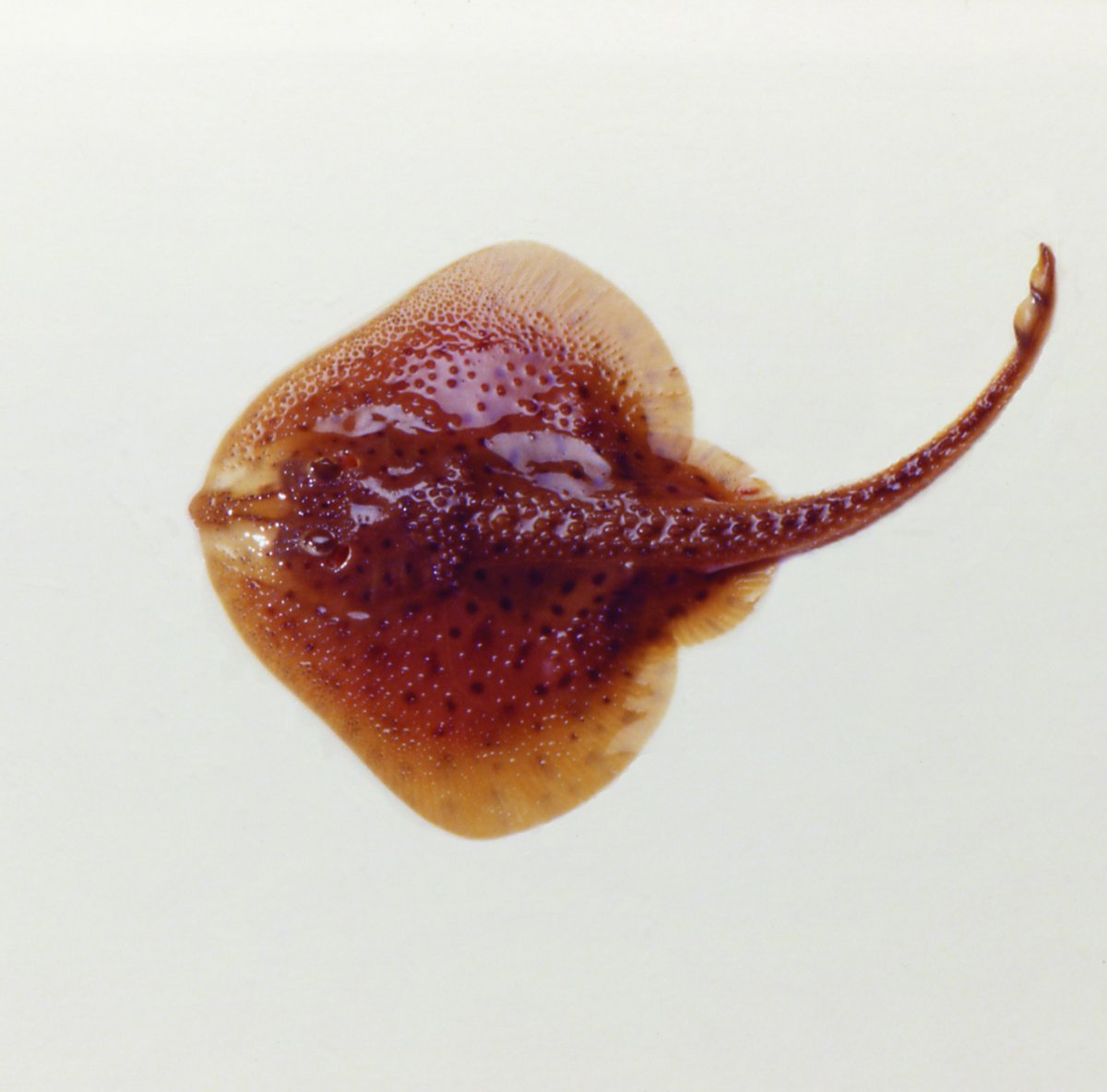
- Diet
- Feeds mostly on decapod crustaceans and amphipods; polychaete worms are also important prey. Other invertebrates and small benthic fishes are taken less often.
- Size
- 41–51 cm; Up to 54 cm
- Range
- Native to the western Atlantic, from Nova Scotia, Canada, to Cape Hatteras, North Carolina, USA; especially abundant in the northern Mid-Atlantic Bight and on Georges Bank.
- Habitat
- Benthic sandy or gravelly habitats from the shore to depths of 90 m; individuals have been recorded as deep as 329 m.
- Lifespan
- Up to 8 years in the wild
- Activity
- More active at night; often spends the day buried in sediment, commonly near depressions made by other animals. Inshore individuals move into shallower water in summer and deeper water in fall and winter.
- Reproduction
- Oviparous. Females deposit paired egg capsules on sandy bottoms, and eggs may be found year-round; eggs are most common in spring and fall. Eggs raised in captivity hatch in 5–6 months, while wild eggs may take up to 12 months, depending on temperature.
- Conservation
- Least Concern (2020 IUCN assessment)
- Getting around
- A little skate can “punt” across the seafloor. Leg-like lobes on its pelvic fins push against the sediment, then the skate glides briefly on its wings before resetting them; the lobes can also act as turning pivots.
- Signals and sounds
- Its tail contains an electric organ that intermittently produces a weak electric field. This signal is thought to aid communication and may help potential mates find one another.
- Sensing the world
- The little skate has many electrosensory ampullae of Lorenzini around its mouth—sensory organs that detect electrical cues in the water. They help it locate prey buried in the seafloor.
- Life cycles
- Females lay amber-colored egg capsules in pairs on sandy bottoms. Each roughly rectangular case holds one fertilized egg and has hollow, tendril-bearing horns that help anchor it to the substrate.
- Life cycles
- A rare specimen had male and female reproductive structures on opposite sides of its body, a condition called bilateral gynandromorphy. Such specimens are among the few known examples of this phenomenon in elasmobranch fishes.
Facts
- A little skate can “punt” across the seafloor. Leg-like lobes on its pelvic fins push against the sediment, then the skate glides briefly on its wings before resetting them; the lobes can also act as turning pivots.
- Its tail contains an electric organ that intermittently produces a weak electric field. This signal is thought to aid communication and may help potential mates find one another.
- The little skate has many electrosensory ampullae of Lorenzini around its mouth—sensory organs that detect electrical cues in the water. They help it locate prey buried in the seafloor.
- Females lay amber-colored egg capsules in pairs on sandy bottoms. Each roughly rectangular case holds one fertilized egg and has hollow, tendril-bearing horns that help anchor it to the substrate.
- A rare specimen had male and female reproductive structures on opposite sides of its body, a condition called bilateral gynandromorphy. Such specimens are among the few known examples of this phenomenon in elasmobranch fishes.
Print and study the Little Skate
This species is included in: