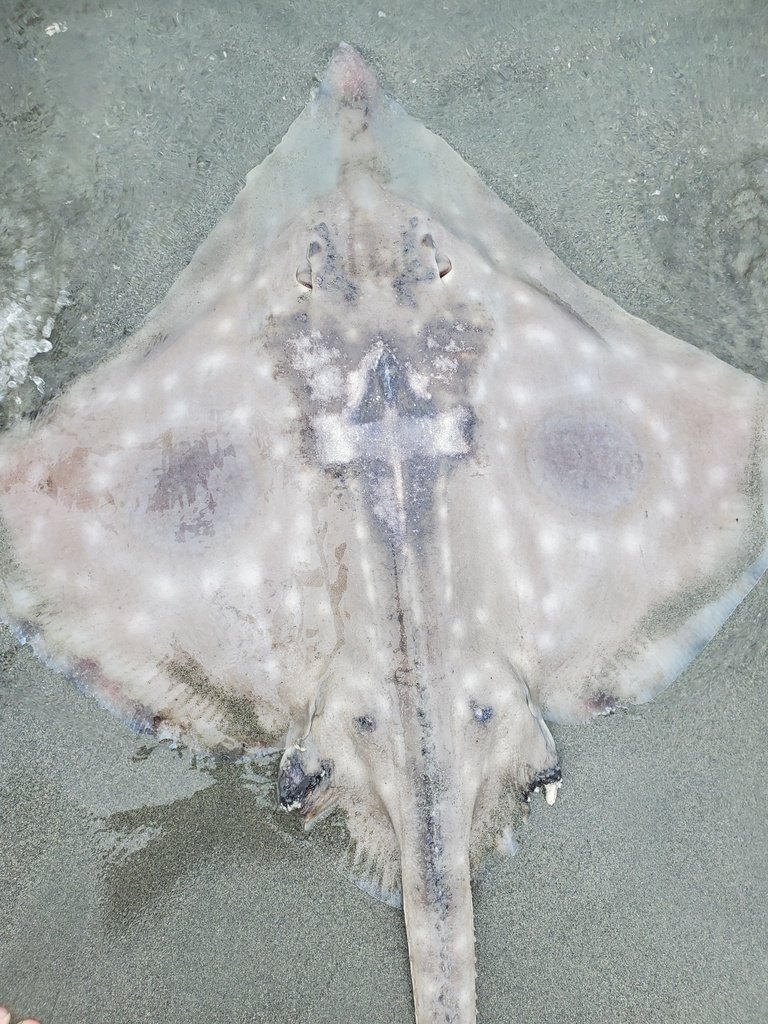
Big Skate
Beringraja binoculata
- Diet
- Benthic invertebrates and small fishes, including polychaete worms, molluscs, crustaceans, and small benthic fishes.
- Range
- Northeastern Pacific Ocean, from the eastern Bering Sea and Aleutian Islands south to Cedros Island off central Baja California; rare south of Point Conception, California.
- Habitat
- Coastal bays, estuaries, and the continental shelf, usually over sandy or muddy bottoms and occasionally among low kelp strands. Usually found from the intertidal zone to 120 m, though reported as deep as 800 m.
- Lifespan
- Up to 15 years in Alaska; up to 26 years in British Columbia
- Activity
- Often buried in sediment with only the eyes showing.
- Reproduction
- Oviparous. Females lay egg cases in pairs on sandy or muddy flats throughout the year; a case may contain one to seven eggs, usually three or four. Young emerge after about 9 months.
- Conservation
- Least Concern (IUCN assessment, 2016)
- Defenses
- Two prominent dark eyespots sit on the wings, one on each side of the body. They are believed to act as decoys that can confuse predators such as the broadnose sevengill shark.
- Camouflage
- A big skate may be almost invisible against the seafloor: it buries itself in sediment until only its eyes remain above the surface.
- Life cycles
- Unlike most skates, the big skate commonly carries several embryos in one egg capsule. A single capsule may hold up to seven eggs.
- Life cycles
- Its egg cases, often called “mermaid’s purses” when washed onto beaches, are unusually large for a skate, measuring 23–31 cm long and 11–19 cm wide.
- Finding food
- Younger big skates eat a somewhat greater proportion of polychaete worms and molluscs than adults do, alongside crustaceans and small bottom-dwelling fishes.
Facts
- Two prominent dark eyespots sit on the wings, one on each side of the body. They are believed to act as decoys that can confuse predators such as the broadnose sevengill shark.
- A big skate may be almost invisible against the seafloor: it buries itself in sediment until only its eyes remain above the surface.
- Unlike most skates, the big skate commonly carries several embryos in one egg capsule. A single capsule may hold up to seven eggs.
- Its egg cases, often called “mermaid’s purses” when washed onto beaches, are unusually large for a skate, measuring 23–31 cm long and 11–19 cm wide.
- Younger big skates eat a somewhat greater proportion of polychaete worms and molluscs than adults do, alongside crustaceans and small bottom-dwelling fishes.
Print and study the Big Skate
This species is included in: