Common Torpedo Ray
Torpedo torpedo
- Diet
- An ambush predator feeding mainly on small benthic bony fishes; large decapod crustaceans are a minor secondary food source. Juveniles also eat a variety of invertebrates.
- Range
- Native to the Mediterranean Sea and the eastern Atlantic Ocean, from the Bay of Biscay to Angola.
- Habitat
- A bottom-dwelling ray usually found close to shore over soft substrates, especially sandy flats and seagrass beds, typically at 2–70 m and occasionally reported as deep as 400 m.
- Lifespan
- Maximum longevity: 10 years in the wild
- Activity
- Solitary and nocturnal; it often rests on the seafloor, partly buried in sediment.
- Reproduction
- Aplacental viviparous: embryos are nourished by yolk and histotroph, or “uterine milk,” produced by the mother. Females have an annual reproductive cycle and produce litters of up to 28 young; gestation lasts 4–8 months, with timing and litter size varying by region.
- Conservation
- Vulnerable (IUCN assessment; 2021)
- Defenses
- Its electric organs can produce shocks of up to 200 volts. The ray uses these discharges to stun prey and deter threats, sometimes in brief bursts called trains.
- What to notice
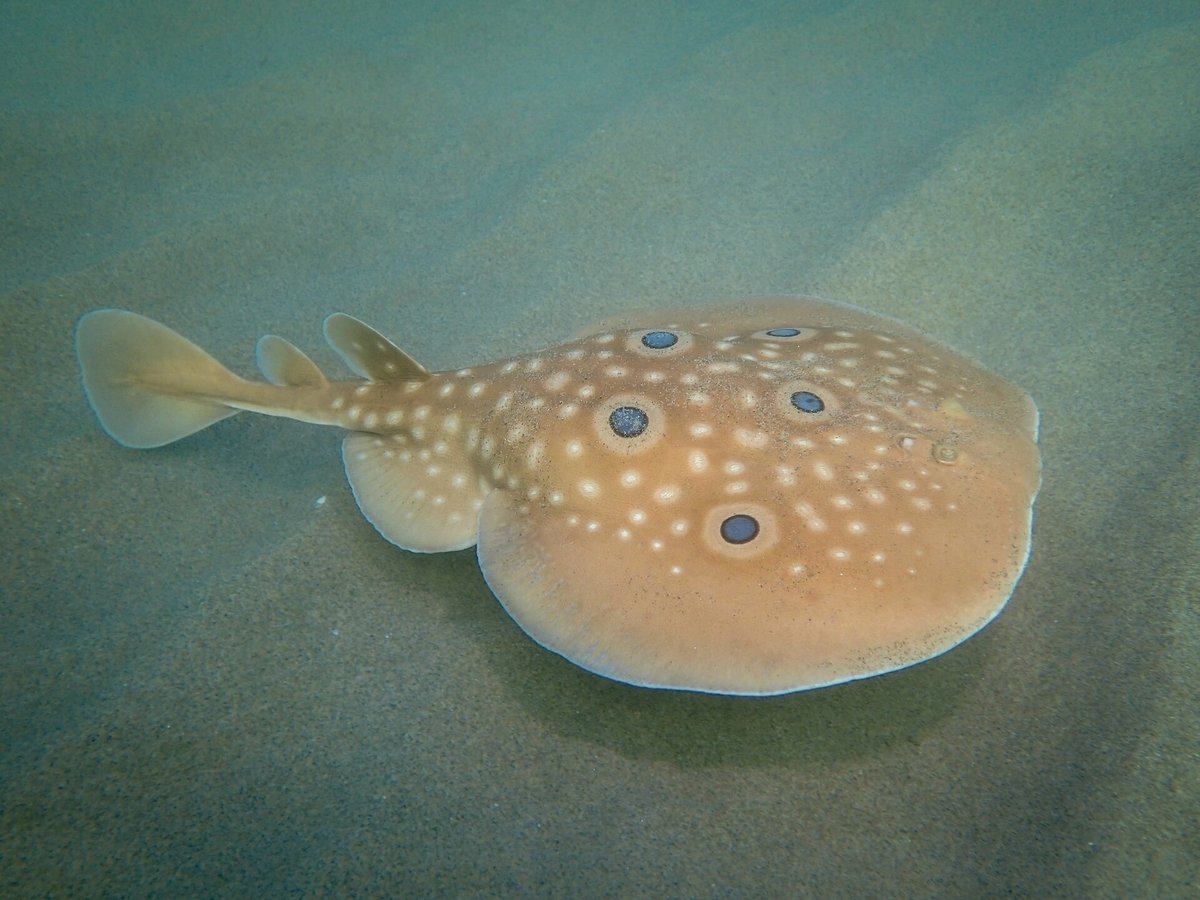
- The common torpedo usually carries five blue ocelli—eye-like spots—arranged symmetrically on its back, but individuals may have anywhere from zero to nine.
- Finding food
- It hunts by ambush: after stunning prey with electricity, it uses movements of its broad disc to guide the immobilized animal to its mouth and swallows it whole.
- Life cycles
- Although it is a ray, it can give birth in both seawater and less-salty settings such as estuaries and lagoons—a documented feature unusual among sharks and rays.
- Life cycles
- Newborns can produce electric shocks of up to four volts. After four months, they nearly double in weight and can generate 26 volts.
Facts
- Its electric organs can produce shocks of up to 200 volts. The ray uses these discharges to stun prey and deter threats, sometimes in brief bursts called trains.
- The common torpedo usually carries five blue ocelli—eye-like spots—arranged symmetrically on its back, but individuals may have anywhere from zero to nine.
- It hunts by ambush: after stunning prey with electricity, it uses movements of its broad disc to guide the immobilized animal to its mouth and swallows it whole.
- Although it is a ray, it can give birth in both seawater and less-salty settings such as estuaries and lagoons—a documented feature unusual among sharks and rays.
- Newborns can produce electric shocks of up to four volts. After four months, they nearly double in weight and can generate 26 volts.
Print and study the Common Torpedo Ray
This species is included in: