Bluespotted Ribbontail Ray
Taeniura lymma
- Diet
- Excavates sand pits to find molluscs, polychaete worms, shrimps, crabs and small benthic bony fishes.
- Size
- 13–14 cm
- Range
- Widespread in nearshore tropical waters of the Indian and western Pacific Oceans, from South Africa and the Arabian Peninsula through Southeast Asia to northern Australia and Pacific islands as far east as the Solomon Islands.
- Habitat
- A bottom-dwelling ray of nearshore coral reefs and adjacent sandy flats, also found in the intertidal zone, tidal pools and near seagrass beds.
- Activity
- Usually shelters alone during the day in caves, under coral ledges or beneath debris. At night, small groups move onto shallow sandy flats with the rising tide to feed, then separate and return to reef shelters as the tide recedes.
- Reproduction
- Ovoviviparous; females produce litters of up to seven young. The embryos begin with yolk nutrition and later receive histotroph, or uterine milk, from the mother.
- Conservation
- Least Concern (IUCN assessment, 2021).
- What to notice
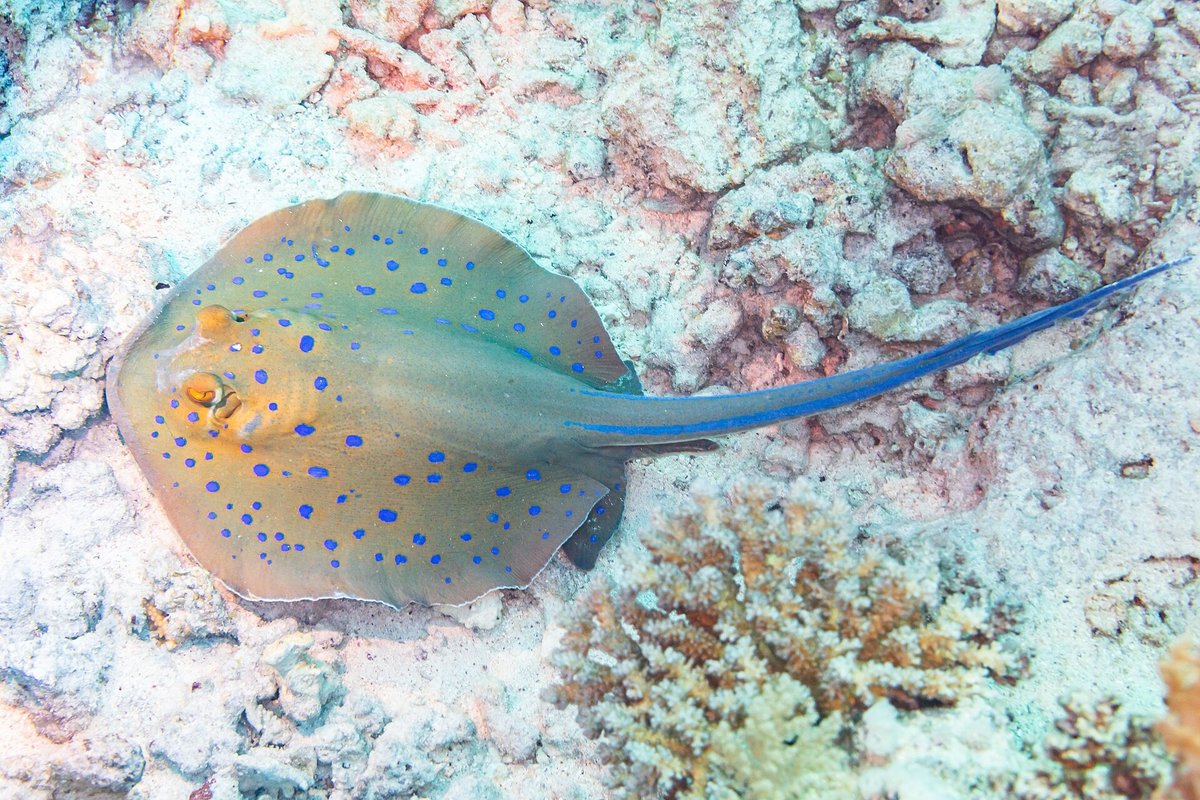
- Its yellowish-brown or green back is marked with numerous neon-blue spots, while two blue stripes run along the tail toward the spines. Individuals from southern Africa may lack those tail stripes.
- Finding food
- At night, the ray excavates pits in sandy flats while searching for prey. Goatfish and other fishes sometimes follow behind, picking up food the ray misses.
- Defenses
- When threatened, it can flee at high speed in a zigzag pattern, making it harder for a pursuer to follow.
- Camouflage
- During the day, a ray may hide beneath a coral ledge or piece of debris with only its tail protruding. Unlike many stingrays, it seldom buries itself in sand.
- Living connections
- It has been observed soliciting cleaning from bluestreak cleaner wrasse by raising the edges of its disc and pelvic fins.
- Venomous
- Venomous
Facts
- Its yellowish-brown or green back is marked with numerous neon-blue spots, while two blue stripes run along the tail toward the spines. Individuals from southern Africa may lack those tail stripes.
- At night, the ray excavates pits in sandy flats while searching for prey. Goatfish and other fishes sometimes follow behind, picking up food the ray misses.
- When threatened, it can flee at high speed in a zigzag pattern, making it harder for a pursuer to follow.
- During the day, a ray may hide beneath a coral ledge or piece of debris with only its tail protruding. Unlike many stingrays, it seldom buries itself in sand.
- It has been observed soliciting cleaning from bluestreak cleaner wrasse by raising the edges of its disc and pelvic fins.
Print and study the Bluespotted Ribbontail Ray
This species is included in: