Southern Stingray
Hypanus americanus
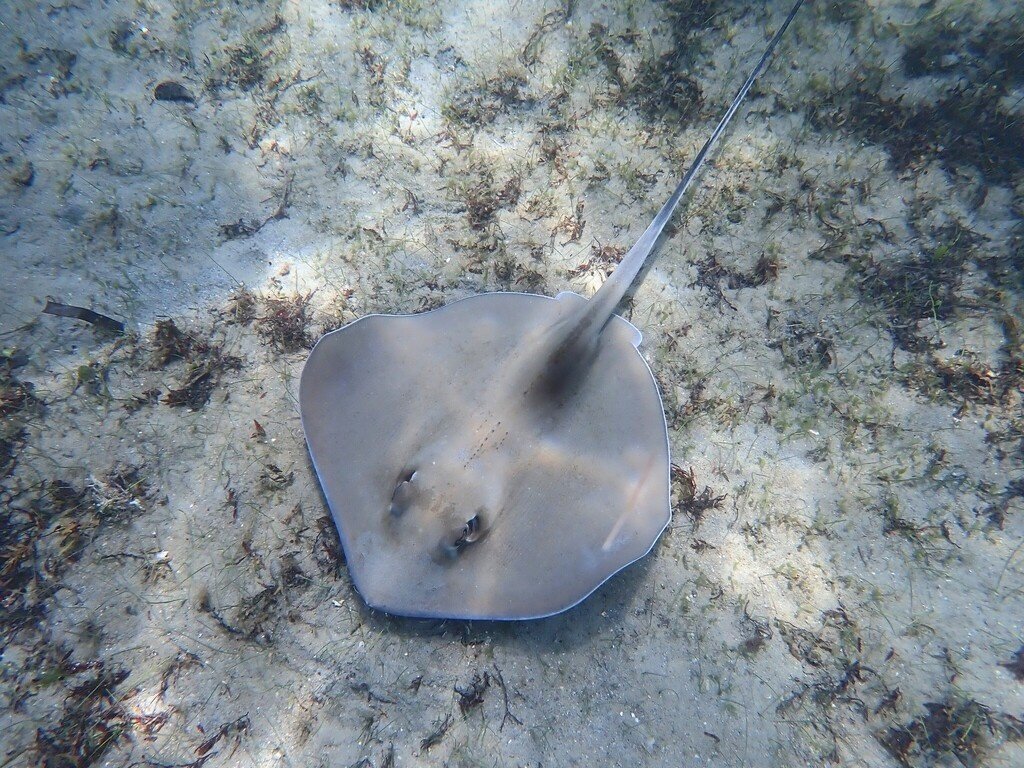
- Diet
- An opportunistic predator that feeds on small fishes, worms, crustaceans and bivalves.
- Range
- Tropical and subtropical Western Atlantic waters, from New Jersey to southern Brazil.
- Habitat
- A bottom-dwelling ray of shallow coastal waters and seabed habitats, where it may rest partly buried in sediment.
- Activity
- Nocturnal; generally bottom-dwelling and often solitary or found in pairs.
- Reproduction
- Ovoviviparous: embryos develop inside the mother, first using yolk and later receiving nutrients from uterine milk. Females usually reproduce annually, giving live birth after a pregnancy of about seven to eight months.
- Conservation
- Near Threatened
- Finding food
- A southern stingray can uncover prey by spraying water from its mouth or beating its fins to disturb the seafloor. It then searches the exposed sediment for hidden animals.
- Remarkable adaptations
- Its eyes sit on top of its head, while spiracles—small openings behind the eyes—draw in water even when the ray is lying on or partly buried in the seabed.
- Getting around
- The ray’s broad pectoral fins move in traveling waves, giving it the maneuverability needed to forage, escape predators and move quickly along the bottom.
- Living connections
- When a southern stingray digs through the substrate, it can expose hidden fish that double-crested cormorants follow behind and eat. This is a documented commensal feeding association, in which one species gains food from another’s activity.
- Sensing the world
- Southern stingrays can detect electric fields from concealed prey using Ampullae of Lorenzini, sensory organs concentrated around the head.
- Venomous
- Venomous
Facts
- A southern stingray can uncover prey by spraying water from its mouth or beating its fins to disturb the seafloor. It then searches the exposed sediment for hidden animals.
- Its eyes sit on top of its head, while spiracles—small openings behind the eyes—draw in water even when the ray is lying on or partly buried in the seabed.
- The ray’s broad pectoral fins move in traveling waves, giving it the maneuverability needed to forage, escape predators and move quickly along the bottom.
- When a southern stingray digs through the substrate, it can expose hidden fish that double-crested cormorants follow behind and eat. This is a documented commensal feeding association, in which one species gains food from another’s activity.
- Southern stingrays can detect electric fields from concealed prey using Ampullae of Lorenzini, sensory organs concentrated around the head.
Print and study the Southern Stingray
This species is included in: