Bonnethead
Sphyrna tiburo
- Diet
- Omnivorous; feeds mainly on crustaceans and also consumes seagrass, mollusks, and small fish.
- Size
- 80–90 cm
- Range
- Both coasts of the Americas, from the western North Atlantic and Gulf of Mexico to Brazil, and from southern California to northern Peru in the eastern Pacific.
- Habitat
- Shallow coastal waters, especially estuaries and bays over seagrass, mud, and sandy bottoms.
- Lifespan
- Maximum longevity: 6.5 years in the wild
- Activity
- Active and constantly swimming; often moves in small groups and shifts position with water temperature.
- Reproduction
- Viviparous. Females give birth to live young after a gestation period of about 4.5–5.0 months; four to twelve pups are born in late summer and early fall.
- Conservation
- Largely Depleted, classified by the IUCN since October 2021
- What to notice
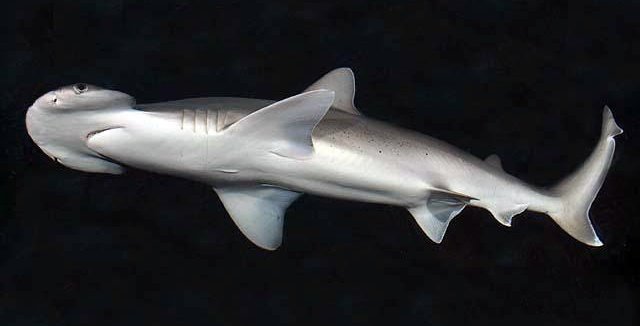
- The bonnethead is the only known shark with sex-based differences in head shape. Adult females have broadly rounded heads, while mature males develop a distinct bulge along the front edge of the head.
- Getting around
- Its small, spade-shaped head is less effective for steering than the larger head shapes of other hammerheads, so the bonnethead relies heavily on its large pectoral fins for swimming.
- Finding food
- While searching the seafloor, it sweeps its head in arcs like a metal detector. It detects tiny electrical disturbances from buried prey, then turns sharply and bites into the sediment.
- Finding food
- The bonnethead eats seagrass as well as animal prey, making it one of only two shark species known to be omnivorous. Studies reported that it can digest seagrass with at least moderate efficiency.
- Life cycles
- Bonnetheads normally reproduce by giving birth to live young, but a female at a Nebraska zoo produced a pup by parthenogenesis—a form of reproduction without fertilization; DNA analysis found the pup matched its mother.
Facts
- The bonnethead is the only known shark with sex-based differences in head shape. Adult females have broadly rounded heads, while mature males develop a distinct bulge along the front edge of the head.
- Its small, spade-shaped head is less effective for steering than the larger head shapes of other hammerheads, so the bonnethead relies heavily on its large pectoral fins for swimming.
- While searching the seafloor, it sweeps its head in arcs like a metal detector. It detects tiny electrical disturbances from buried prey, then turns sharply and bites into the sediment.
- The bonnethead eats seagrass as well as animal prey, making it one of only two shark species known to be omnivorous. Studies reported that it can digest seagrass with at least moderate efficiency.
- Bonnetheads normally reproduce by giving birth to live young, but a female at a Nebraska zoo produced a pup by parthenogenesis—a form of reproduction without fertilization; DNA analysis found the pup matched its mother.
Print and study the Bonnethead
This species is included in: