Scalloped Hammerhead
Sphyrna lewini
- Diet
- An opportunistic predator that mainly eats bony fish and also takes cephalopods, crustaceans, smaller sharks, rays, and—in the Indo-West Pacific—sea snakes.
- Range
- Worldwide in warm-temperate and tropical coastal waters, from 46°N to 36°S.
- Habitat
- A coastal pelagic shark found over continental and insular shelves and in nearby deeper water. Young sharks use shallow bays and mangroves; adults are often closer to shore by day and farther offshore at night.
- Activity
- Often found close to shore during the day and hunting farther offshore at night. It may travel in large schools, with younger sharks generally closer to the surface than adults.
- Reproduction
- Gives live birth after a reported gestation of around 12 months, producing litters of 12–41 pups. Shallow coastal areas and mangroves serve as nursery habitat, and parental care is not seen.
- Conservation
- Critically Endangered on the IUCN Red List assessment cited as of 2019; overfishing is identified as the main cause of population decline.
- What to notice
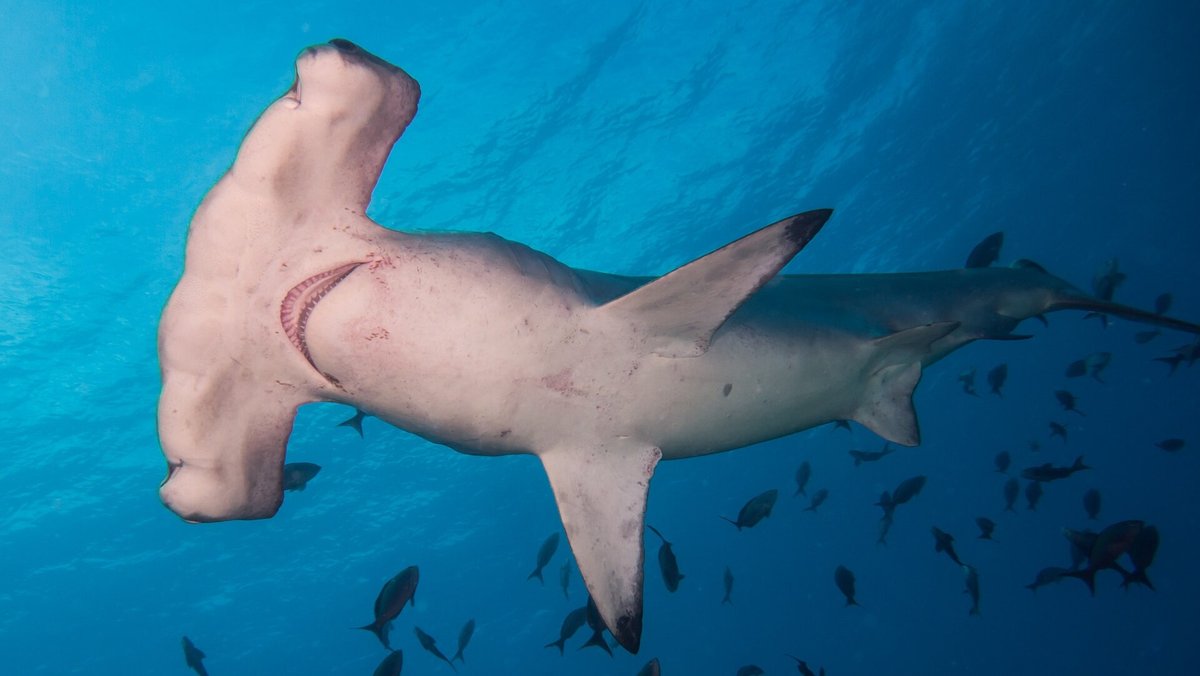
- The head has a central indentation flanked by two smaller indentations, creating the scalloped edge that gives this shark its name. Its eyes and nostrils sit at the tips of the wide head extensions.
- Finding food
- A scalloped hammerhead can use its broad head to pin stingrays against the seafloor. Sensory cells across the head also help it detect prey.
- Social lives
- These sharks can form schools numbering in the hundreds. Young sharks tend to remain nearer the surface, while adults are generally found deeper.
- Seasonal journeys
- Scalloped hammerheads use several environmental cues for navigation, including Earth’s magnetic field, and show homing behavior during ocean travel.
- Raising the next generation
- Females return to coastal nursery areas to give birth, and juveniles may remain in mangrove root systems for around three years before migrating back toward offshore waters.
Facts
- The head has a central indentation flanked by two smaller indentations, creating the scalloped edge that gives this shark its name. Its eyes and nostrils sit at the tips of the wide head extensions.
- A scalloped hammerhead can use its broad head to pin stingrays against the seafloor. Sensory cells across the head also help it detect prey.
- These sharks can form schools numbering in the hundreds. Young sharks tend to remain nearer the surface, while adults are generally found deeper.
- Scalloped hammerheads use several environmental cues for navigation, including Earth’s magnetic field, and show homing behavior during ocean travel.
- Females return to coastal nursery areas to give birth, and juveniles may remain in mangrove root systems for around three years before migrating back toward offshore waters.
Print and study the Scalloped Hammerhead
This species is included in: