Greenland Shark
Somniosus microcephalus
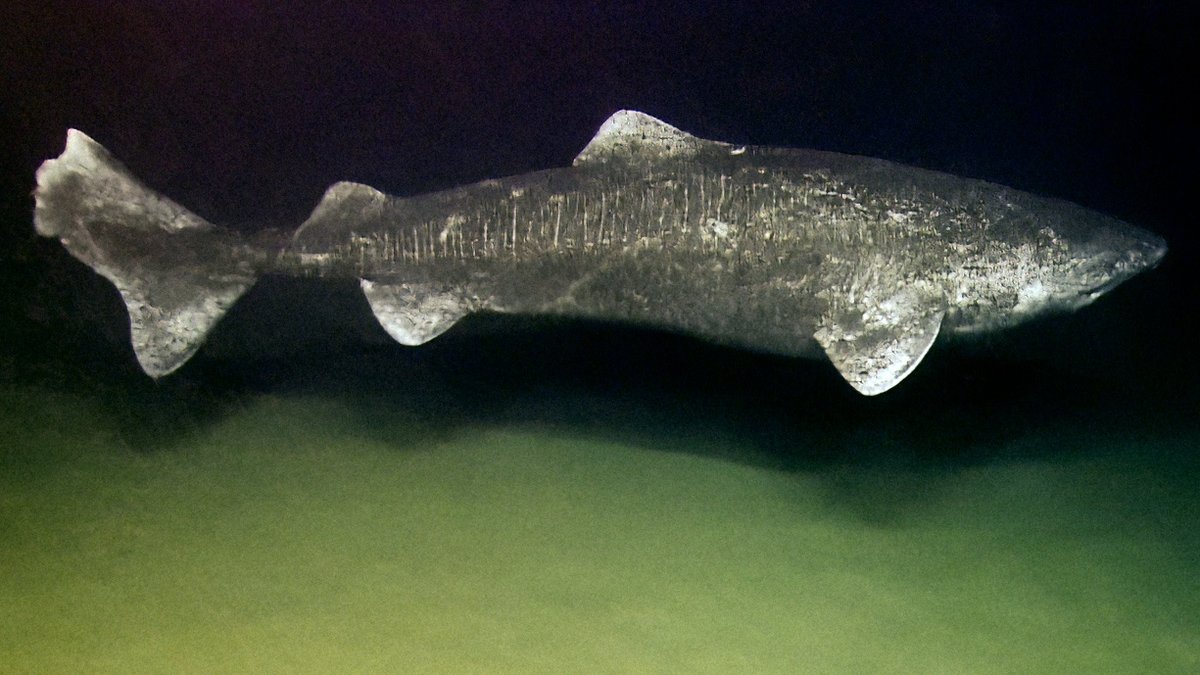
- Diet
- A generalist feeder, acting both as an active predator and a scavenger. It eats fish, seals, squid and other marine animals, and has also been found with carrion in its stomach.
- Range
- North Atlantic and Arctic Oceans, with records farther south including the Gulf of Mexico and Mid-Atlantic Ridge.
- Habitat
- Cold, deep marine waters, typically at depths of 0–1,500 m; it has been observed as deep as 2,200 m.
- Lifespan
- Estimated lifespan: 272–510 years
- Activity
- Sluggish and slow-moving, with activity and distribution linked to depth and temperature. It may migrate vertically between shallow and deep water and is thought to ambush sleeping, injured or sick marine mammals.
- Reproduction
- Females give birth to live young after an estimated gestation period of 8–18 years. Sexual maturity is reached at around 150 years of age.
- Sensing the world
- A copepod—a small crustacean parasite—often attaches to the shark’s eyes. Eye damage can be extensive, yet the shark can still locate prey and move through dark water using smell, hearing and its lateral line, a network that detects vibrations and pressure changes.
- Finding food
- When feeding on a large carcass, the shark anchors into the flesh with thin upper teeth while its broad lower teeth cut away chunks. It can also create suction by expanding its mouth, which may help explain why whole prey are sometimes found in its stomach.
- Life cycles
- Greenland sharks grow and mature exceptionally slowly: they may not reach sexual maturity until around 150 years old, and their estimated gestation lasts 8–18 years. These traits make recovery from fishing pressure especially difficult.
- Defenses
- Its meat is unsafe to eat fresh because of naturally high levels of urea and trimethylamine oxide. In Iceland, it is fermented and dried for months to produce the traditional food hákarl.
- Getting around
- Although it is a very large shark, it swims slowly, with an average speed of 0.34 m per second and a fastest cruising speed of about 0.74 m per second. Biologists propose that it may approach sleeping seals quietly or rely on scavenging rather than prolonged pursuit.
- Poisonous
- Poisonous
Facts
- A copepod—a small crustacean parasite—often attaches to the shark’s eyes. Eye damage can be extensive, yet the shark can still locate prey and move through dark water using smell, hearing and its lateral line, a network that detects vibrations and pressure changes.
- When feeding on a large carcass, the shark anchors into the flesh with thin upper teeth while its broad lower teeth cut away chunks. It can also create suction by expanding its mouth, which may help explain why whole prey are sometimes found in its stomach.
- Greenland sharks grow and mature exceptionally slowly: they may not reach sexual maturity until around 150 years old, and their estimated gestation lasts 8–18 years. These traits make recovery from fishing pressure especially difficult.
- Its meat is unsafe to eat fresh because of naturally high levels of urea and trimethylamine oxide. In Iceland, it is fermented and dried for months to produce the traditional food hákarl.
- Although it is a very large shark, it swims slowly, with an average speed of 0.34 m per second and a fastest cruising speed of about 0.74 m per second. Biologists propose that it may approach sleeping seals quietly or rely on scavenging rather than prolonged pursuit.
Print and study the Greenland Shark
This species is included in: