Basking Shark
Cetorhinus maximus
- Diet
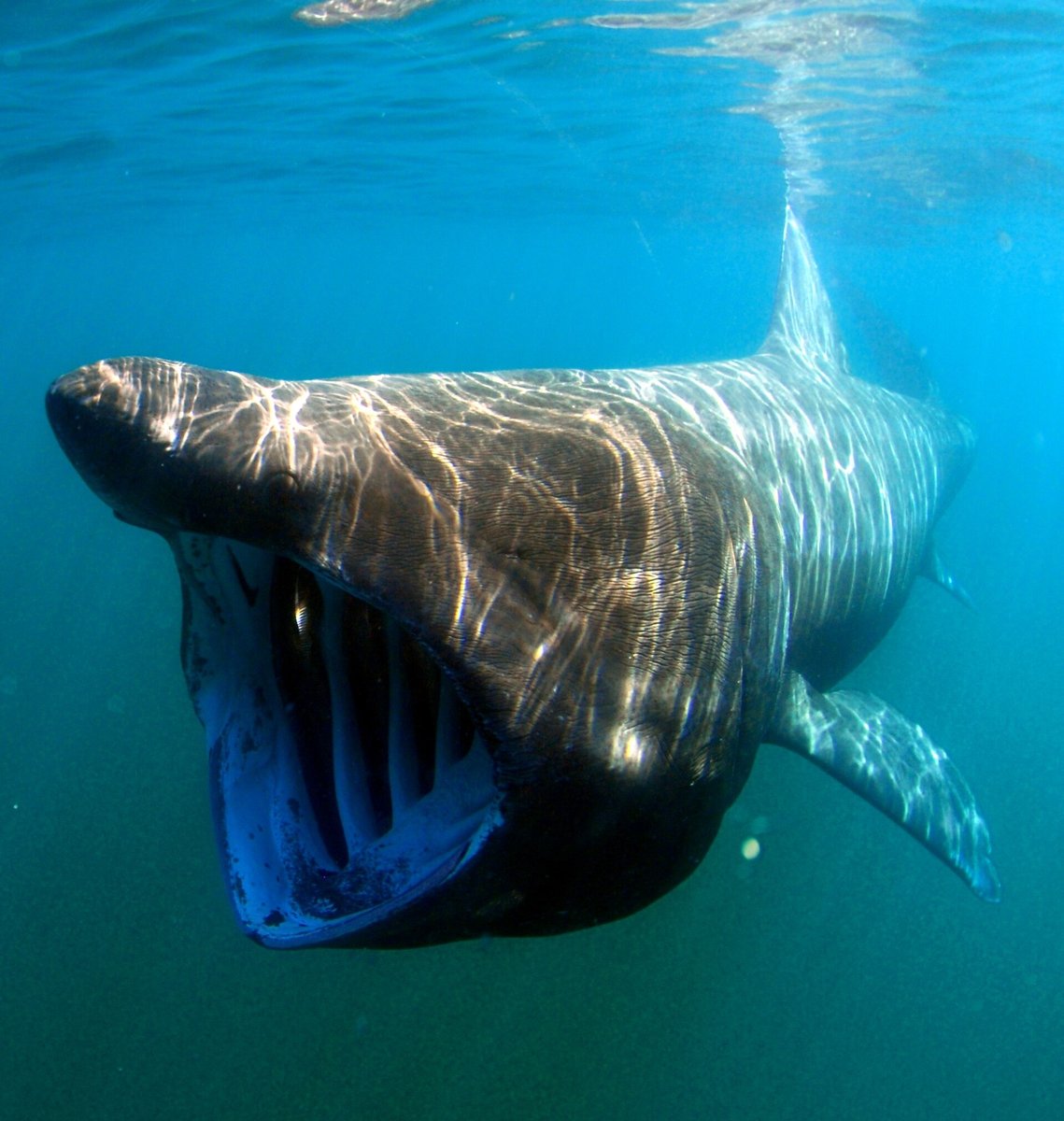
- A ram-feeding filter feeder that strains zooplankton, very small fish, and invertebrates from the water with its gill rakers.
- Size
- Adults: 7–8.5 m; Up to 11 m
- Range
- A cosmopolitan migratory species found in boreal to warm-temperate waters worldwide.
- Habitat
- Coastal-pelagic waters around continental shelves, from the surface to at least 910 m; it occasionally enters brackish water and is often seen near land and in bays.
- Lifespan
- About 50 years according to an expert estimate; EOL reports maximum longevity of 32 years in the wild.
- Activity
- Active year-round and migratory. It often feeds near the surface in warmer months, moves to deeper water in winter, and may gather in small shoals or larger plankton-associated groups.
- Reproduction
- Ovoviviparous, meaning embryos develop inside the mother from yolk before birth. Gestation is thought to last over a year, perhaps two to three years; young are reportedly born at 1.5–2 m, and breeding may occur every two to four years.
- Conservation
- Endangered on the IUCN Red List; the eastern North Pacific population is a U.S. National Marine Fisheries Service species of concern. In New Zealand it is classified as Threatened—Nationally Vulnerable under the New Zealand Threat Classification System.
- Finding food
- Its enormous mouth can open to about 1 m wide, while dark, bristle-like gill rakers trap plankton as water passes over the gills. Unlike whale and megamouth sharks, it relies on forward swimming to push water through its gills.
- Seasonal journeys
- Satellite tagging has recorded seasonal journeys of thousands of kilometres as basking sharks follow rich patches of zooplankton, including journeys across the equator in the western Atlantic.
- Social lives
- In summer, basking sharks may gather in dense zooplankton patches. Small sex-segregated shoals have been reported, and groups in the Bay of Fundy and Hebrides have been seen swimming nose to tail in circles.
- Remarkable adaptations
- The species does not hibernate: in winter, individuals often move into deeper water, where tracking has recorded depths approaching 900 m and movements consistent with feeding on overwintering zooplankton.
- Getting around
- A basking shark can breach completely out of the water. The behavior may help dislodge parasites or may function as a display, but the supplied source describes these interpretations as uncertain.
Facts
- Its enormous mouth can open to about 1 m wide, while dark, bristle-like gill rakers trap plankton as water passes over the gills. Unlike whale and megamouth sharks, it relies on forward swimming to push water through its gills.
- Satellite tagging has recorded seasonal journeys of thousands of kilometres as basking sharks follow rich patches of zooplankton, including journeys across the equator in the western Atlantic.
- In summer, basking sharks may gather in dense zooplankton patches. Small sex-segregated shoals have been reported, and groups in the Bay of Fundy and Hebrides have been seen swimming nose to tail in circles.
- The species does not hibernate: in winter, individuals often move into deeper water, where tracking has recorded depths approaching 900 m and movements consistent with feeding on overwintering zooplankton.
- A basking shark can breach completely out of the water. The behavior may help dislodge parasites or may function as a display, but the supplied source describes these interpretations as uncertain.
Print and study the Basking Shark
This species is included in: