Cookiecutter Shark
Isistius brasiliensis
- Diet
- A facultative ectoparasite that removes tissue from larger animals but also eats smaller prey whole.
- Size
- Males: Up to 42 cm; Females: Up to 56 cm
- Range
- Tropical and warm-temperate oceanic basins worldwide, especially between 20°N and 20°S.
- Habitat
- Open ocean, frequently near islands; found from the upper water column to depths of 3.7 km.
- Activity
- Conducts a daily vertical migration: it approaches the surface around dusk and descends with dawn. During the day it is usually found at 1–3.7 km depth; at night it generally remains below 85 m.
- Reproduction
- Aplacental viviparous; embryos are nourished by yolk. Females have two functional uteri and produce litters of 6–12 pups.
- Conservation
- Least Concern (IUCN assessment, 2018)
- Finding food
- Its name comes from the neat, round plugs of flesh it removes from much larger animals. The resulting crater-like wounds average 5 cm across and 7 cm deep.
- Camouflage
- Light-producing organs called photophores cover almost the entire underside and create a green glow. This counter-illumination can make the shark’s silhouette harder to see from below.
- Camouflage
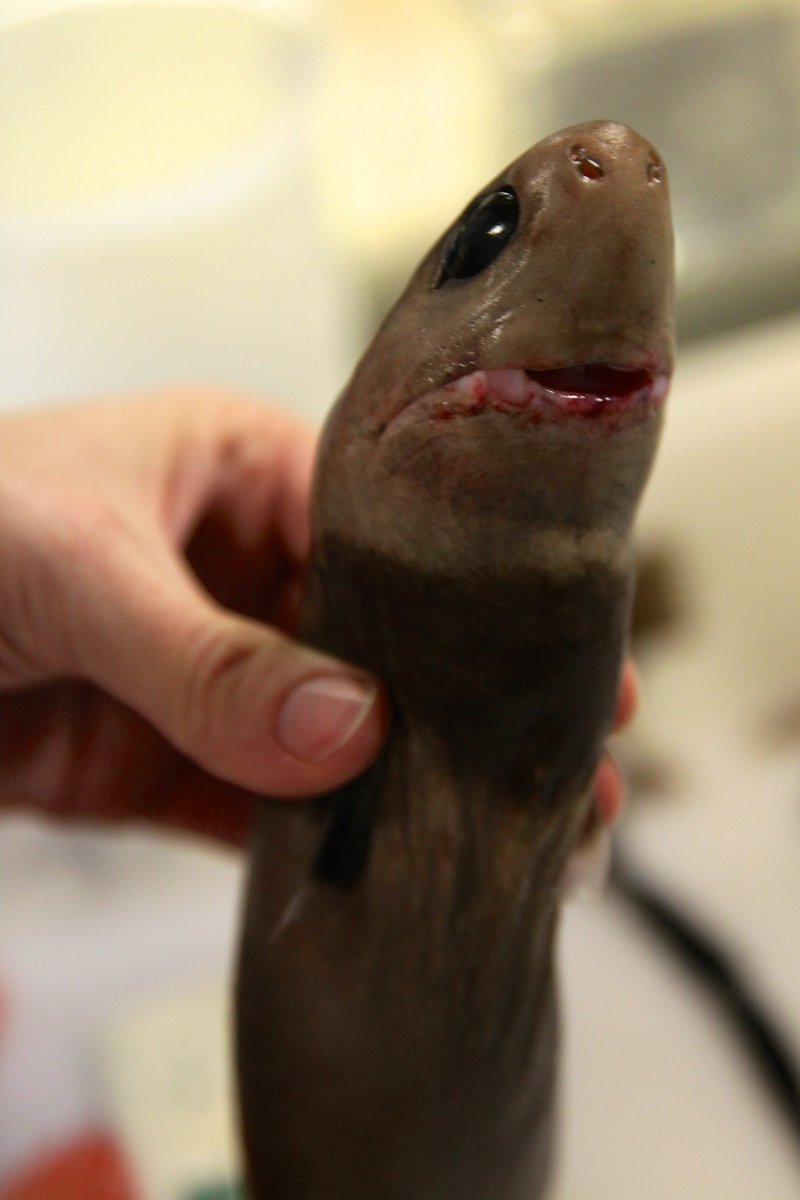
- A dark collar around the throat does not glow. It may resemble the silhouette of a small fish and act as a lure, although this proposed function is not certain.
- Finding food
- The shark grips prey with suction from its lips and mouth, anchors with its upper teeth, then uses its broad lower teeth to cut a circular plug while twisting its body.
- Life cycles
- It regularly replaces its teeth by shedding the lower teeth in whole rows. Old tooth sets are swallowed, allowing the shark to recycle their calcium.
Facts
- Its name comes from the neat, round plugs of flesh it removes from much larger animals. The resulting crater-like wounds average 5 cm across and 7 cm deep.
- Light-producing organs called photophores cover almost the entire underside and create a green glow. This counter-illumination can make the shark’s silhouette harder to see from below.
- A dark collar around the throat does not glow. It may resemble the silhouette of a small fish and act as a lure, although this proposed function is not certain.
- The shark grips prey with suction from its lips and mouth, anchors with its upper teeth, then uses its broad lower teeth to cut a circular plug while twisting its body.
- It regularly replaces its teeth by shedding the lower teeth in whole rows. Old tooth sets are swallowed, allowing the shark to recycle their calcium.
Print and study the Cookiecutter Shark
This species is included in: