Longnose Sawshark
Pristiophorus cirratus
- Diet
- Feeds primarily on small crustaceans, locating prey along the seafloor.
- Size
- Up to 1.37 m
- Range
- Eastern Indian Ocean around southern Australia and Tasmania.
- Habitat
- Continental-shelf waters at depths of 20–600 m, usually over sandy or gravelly offshore areas; it may occasionally enter bays and estuaries.
- Lifespan
- Around 15 years
- Activity
- Forages along the ocean floor, using its barbels to locate prey.
- Reproduction
- Ovoviviparous; females give birth every other winter to litters of 6–19 pups after a 12-month gestation. Newborns are 27–37 cm long, with their teeth folded against the snout.
- Conservation
- Least Concern (IUCN assessment, 2020)
- What to notice
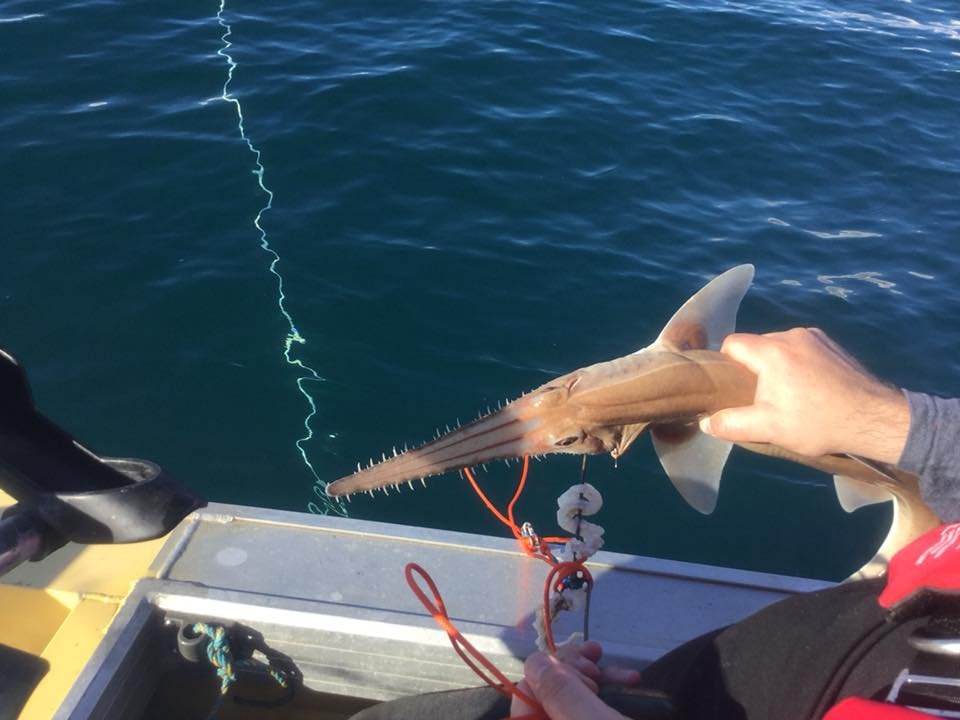
- The sawshark’s long rostrum—the toothed, saw-like snout—can make up as much as 30% of its total body length.
- Finding food
- Its barbels are feelers positioned on the rostrum. The shark sweeps them over the seafloor, then uses its snout teeth to stir sediment and strike prey.
- What to notice
- A longnose sawshark can be mistaken for a sawfish, but the two are built differently: the sawshark has five gill openings on the sides of its head, while a sawfish’s gills are underneath.
- Life cycles
- Newborns arrive with their teeth folded flat against the snout, a temporary arrangement that protects the mother during birth.
- Raising the next generation
- Females produce a litter only every other winter, with 6–19 pups in a litter.
Facts
- The sawshark’s long rostrum—the toothed, saw-like snout—can make up as much as 30% of its total body length.
- Its barbels are feelers positioned on the rostrum. The shark sweeps them over the seafloor, then uses its snout teeth to stir sediment and strike prey.
- A longnose sawshark can be mistaken for a sawfish, but the two are built differently: the sawshark has five gill openings on the sides of its head, while a sawfish’s gills are underneath.
- Newborns arrive with their teeth folded flat against the snout, a temporary arrangement that protects the mother during birth.
- Females produce a litter only every other winter, with 6–19 pups in a litter.
Print and study the Longnose Sawshark
This species is included in: