Giant Oceanic Manta Ray
Mobula birostris
- Diet
- Feeds mainly on zooplankton and also consumes fish and other mesopelagic prey; it filter-feeds by channeling water through its gill structures.
- Range
- Circumglobal in tropical and temperate waters, with records from both hemispheres.
- Habitat
- Ocean-going and usually far from land; often associated with offshore islands, productive upwellings and plankton-rich coastal waters.
- Activity
- Swims steadily in a straight line in deep water, while nearer shore it may bask or swim idly. It must keep swimming to move water across its gills and migrates toward areas where upwellings increase zooplankton availability.
- Reproduction
- Males mature at about 4 m disc width and females at about 5 m. Usually one pup develops inside the female after a thought-to-be 12–13-month gestation; females reproduce every two to three years.
- Conservation
- Endangered on the IUCN Red List; a New Zealand assessment published in 2018 classified it as data deficient with the qualifier “threatened overseas.”
- Finding food
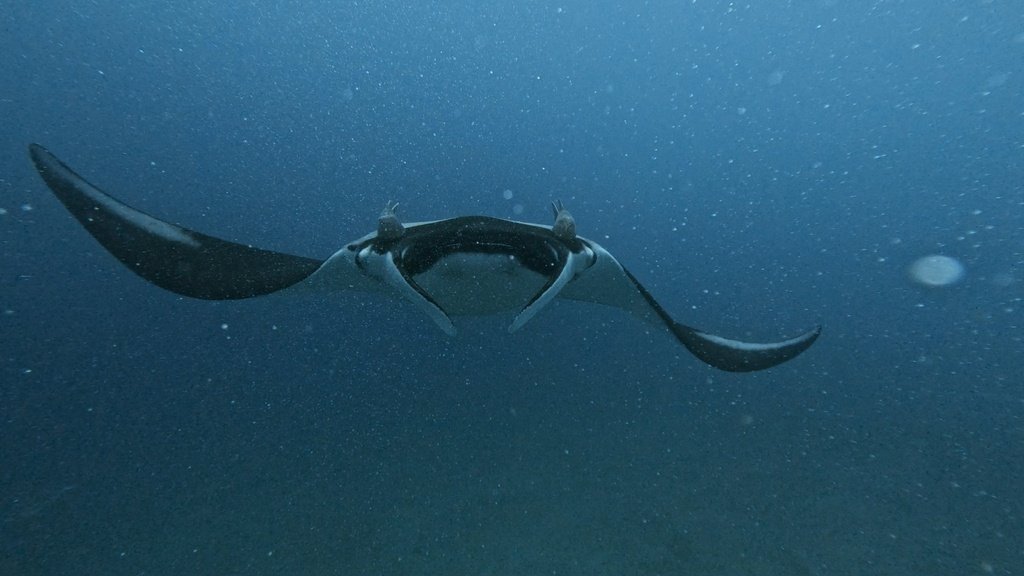
- Its paired cephalic fins can curl into spirals while it swims or flare outward to funnel plankton-rich water into its wide mouth.
- Social lives
- A single plankton-rich feeding site may draw together as many as 50 giant oceanic manta rays. The rays herd prey into a tight group before sweeping through it with their mouths open.
- Living connections
- The species sometimes pauses at a reef cleaning station, holding nearly still while cleaner fish remove loose skin and external parasites.
- What to notice
- Its markings can identify individuals: the dark upper surface contrasts with a white underside that often has dark spots clustered around the lower abdomen.
- Life cycles
- The developing pup begins inside an egg case within the female’s oviduct, then continues growing there after hatching while receiving nourishment from a milky secretion. A fully developed pup is about 1.4 m in disc width and weighs 9 kg.
Facts
- Its paired cephalic fins can curl into spirals while it swims or flare outward to funnel plankton-rich water into its wide mouth.
- A single plankton-rich feeding site may draw together as many as 50 giant oceanic manta rays. The rays herd prey into a tight group before sweeping through it with their mouths open.
- The species sometimes pauses at a reef cleaning station, holding nearly still while cleaner fish remove loose skin and external parasites.
- Its markings can identify individuals: the dark upper surface contrasts with a white underside that often has dark spots clustered around the lower abdomen.
- The developing pup begins inside an egg case within the female’s oviduct, then continues growing there after hatching while receiving nourishment from a milky secretion. A fully developed pup is about 1.4 m in disc width and weighs 9 kg.
Print and study the Giant Oceanic Manta Ray
This species is included in: