Reef Manta Ray
Mobula alfredi
- Diet
- Filter-feeds on zooplankton by sieving seawater.
- Range
- Tropical and subtropical Indo-Pacific, with a few records from the tropical East Atlantic; absent from the West Atlantic and East Pacific in the supplied distribution account.
- Habitat
- Pelagic but primarily coastal, commonly associated with reefs, islands, and nearby feeding or cleaning areas.
- Lifespan
- May live to at least 50 years.
- Activity
- Primarily relatively sedentary, remaining near particular coastal, reef, or island areas; short migrations may occur, including movements associated with zooplankton. It can also make deep feeding dives.
- Reproduction
- Ovoviviparous: embryos develop inside the female’s oviduct, and the female usually gives birth to one pup after a thought-to-be 12–13 month gestation; occasionally two embryos develop simultaneously.
- Conservation
- Vulnerable on the IUCN Red List (2019 assessment).
- Finding food
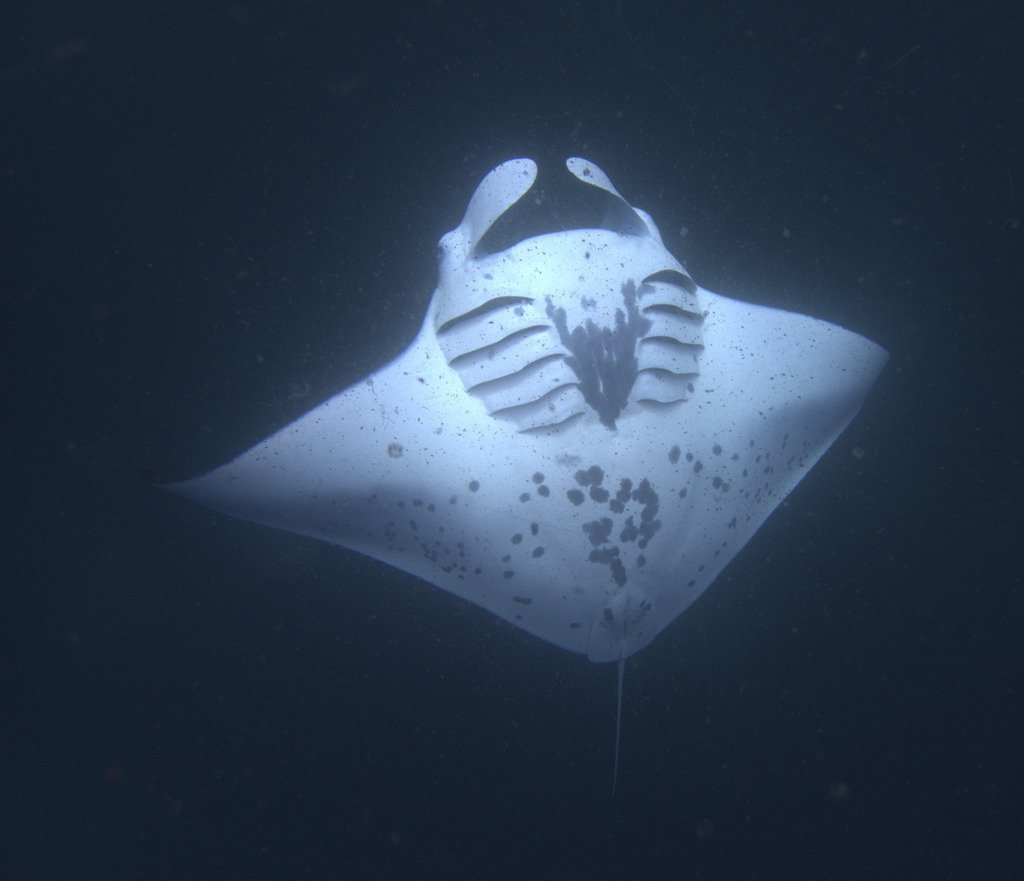
- The paired cephalic fins at the front of the head can roll into spirals while the ray cruises. When feeding, they flare outward and help channel water into the wide mouth.
- Living connections
- A reef manta ray can hold nearly still above a coral patch at a cleaning station while cleaner fish remove organisms from its body.
- What to notice
- Its individual pattern of pale and dark markings can help researchers recognize particular rays. The reef manta’s back commonly shows two lighter areas whose separation forms a Y-like pattern.
- Remarkable adaptations
- In New Caledonia, reef manta rays have been recorded diving to 672 m while searching for food, far below their usual coastal haunts.
- Life cycles
- A newborn is already about 1.4 m across the disc and resembles an adult. It remains in shallow water for a few years while growing.
Facts
- The paired cephalic fins at the front of the head can roll into spirals while the ray cruises. When feeding, they flare outward and help channel water into the wide mouth.
- A reef manta ray can hold nearly still above a coral patch at a cleaning station while cleaner fish remove organisms from its body.
- Its individual pattern of pale and dark markings can help researchers recognize particular rays. The reef manta’s back commonly shows two lighter areas whose separation forms a Y-like pattern.
- In New Caledonia, reef manta rays have been recorded diving to 672 m while searching for food, far below their usual coastal haunts.
- A newborn is already about 1.4 m across the disc and resembles an adult. It remains in shallow water for a few years while growing.
Print and study the Reef Manta Ray
This species is included in: