Spotted Eagle Ray
Aetobatus narinari
- Diet
- Feeds mainly on bivalves, crabs, whelks and other animals living in or on the seafloor; it also eats mollusks, crustaceans, echinoderms, polychaete worms, shrimp, octopuses and some small fish.
- Range
- Recent authorities restrict Aetobatus narinari to the Atlantic Ocean, including the Caribbean and Gulf of Mexico; populations traditionally included in this species from the Indo-Pacific and East Pacific are now recognized as different species.
- Habitat
- Usually found in shallow coastal waters around coral reefs and bays, to depths of 80 m; it also swims freely in open water, often near the surface.
- Activity
- Daily movement is influenced by tides, with one tracking study finding greater activity during high tides. Individuals are commonly seen alone but may form loose groups or schools.
- Reproduction
- Ovoviviparous: eggs are retained inside the female and hatch internally, and the young are born live. After a gestation period of one year, a female may give birth to a maximum of four pups; newborn disc width is 17–35 cm, and maturity occurs in 4–6 years.
- Conservation
- Near Threatened on the IUCN Red List.
- What to notice
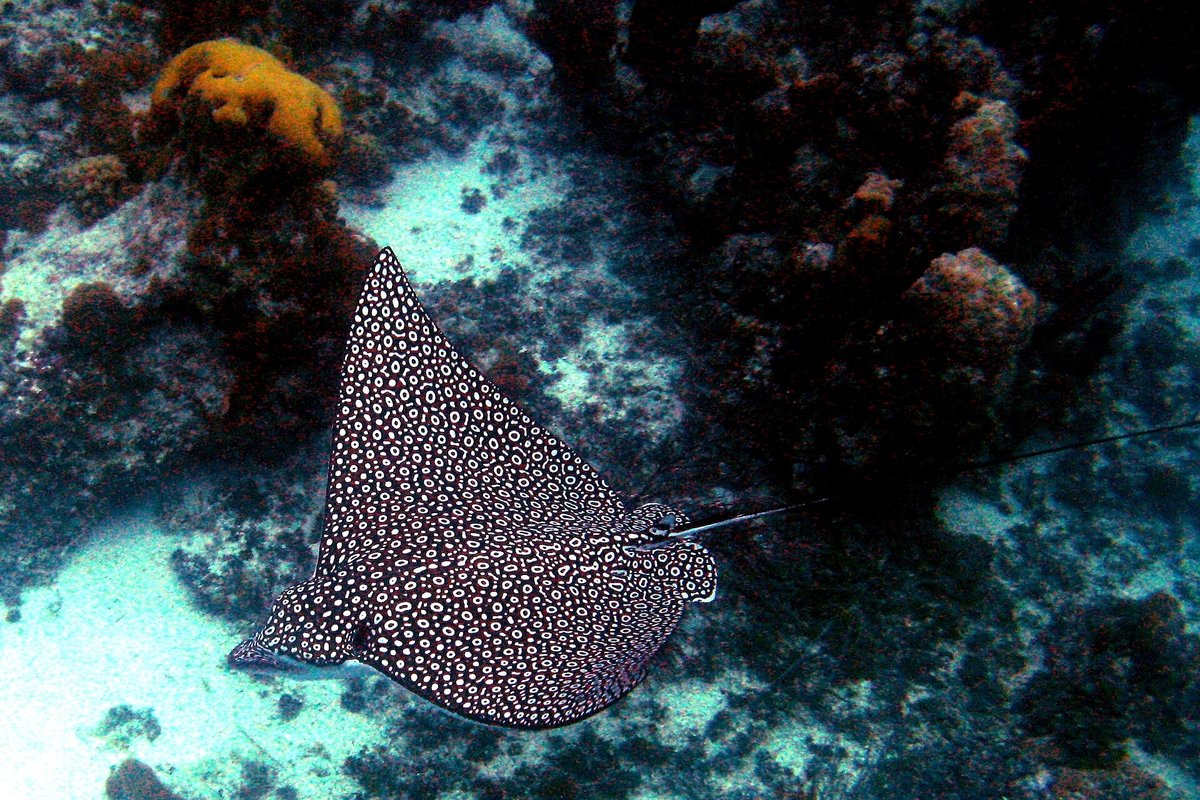
- Its dark back is patterned with white spots or rings, while its flat snout resembles a duck’s bill—two useful clues for identifying it underwater.
- Finding food
- When searching sandy seafloors, it digs with its snout and can become surrounded by a cloud of sand that then streams from its gills.
- Finding food
- A specialized chevron-shaped tooth arrangement helps it crush hard mollusk shells. Calcified supports in the jaws help prevent damage from this hard prey.
- Getting around
- Spotted eagle rays are often seen leaping from the water. They also perform rapid up-and-down movements of the abdomen and pectoral fins, including a display called the extreme pelvic thrust that is most often observed when a ray separates from a group.
- Living connections
- Sharks such as tiger, lemon, bull and great hammerhead sharks prey on spotted eagle rays; sharks have also been observed following females during the birthing season and eating newborn pups.
- Venomous
- Venomous
Facts
- Its dark back is patterned with white spots or rings, while its flat snout resembles a duck’s bill—two useful clues for identifying it underwater.
- When searching sandy seafloors, it digs with its snout and can become surrounded by a cloud of sand that then streams from its gills.
- A specialized chevron-shaped tooth arrangement helps it crush hard mollusk shells. Calcified supports in the jaws help prevent damage from this hard prey.
- Spotted eagle rays are often seen leaping from the water. They also perform rapid up-and-down movements of the abdomen and pectoral fins, including a display called the extreme pelvic thrust that is most often observed when a ray separates from a group.
- Sharks such as tiger, lemon, bull and great hammerhead sharks prey on spotted eagle rays; sharks have also been observed following females during the birthing season and eating newborn pups.
Print and study the Spotted Eagle Ray
This species is included in: