Spotted Wobbegong
Orectolobus maculatus
- Diet
- Feeds at night on fishes and invertebrates.
- Size
- 1.5–1.8 m
- Range
- Endemic to Australia; usually found in tropical waters.
- Habitat
- Adults commonly occur on algae-covered rocky reefs, seagrass meadows and sand; juveniles are mostly found in estuaries.
- Activity
- Nocturnal: it rests during the day and feeds at night.
- Reproduction
- Ovoviviparous, meaning embryos develop inside the mother until they are ready to hatch. Females give birth in spring after a gestation period of almost a year; litters typically contain 20–37 young.
- Conservation
- Least Concern on the IUCN Red List; assessment information supplied for 2015.
- What to notice
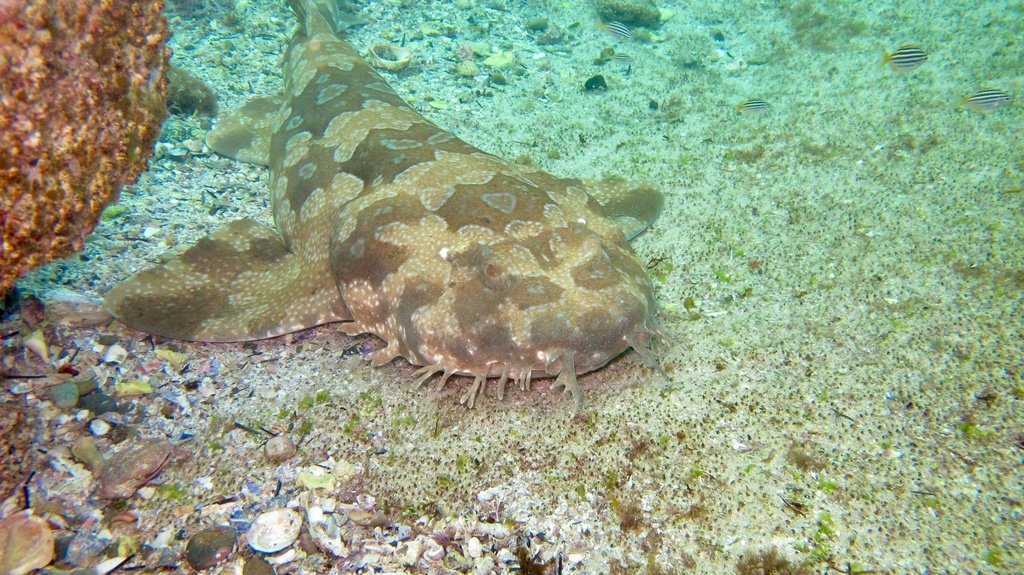
- Its body is covered with distinctive O-shaped spots, a useful field mark for separating it from similar-looking wobbegongs.
- Camouflage
- During the day it can disappear against rocky bottoms: its green, yellow or brown colouring and darker saddles blend with the seafloor.
- Sensing the world
- Pores in its skin detect the electric fields produced by nearby animals. This electroreception helps it locate prey, even when visual clues are limited.
- Social lives
- Spotted wobbegongs may gather in groups, and a study found that many observed individuals repeatedly associated with preferred partners rather than grouping entirely at random.
- Courtship
- Males can fight with other males during the breeding season, and males have also been observed biting females during courtship.
Facts
- Its body is covered with distinctive O-shaped spots, a useful field mark for separating it from similar-looking wobbegongs.
- During the day it can disappear against rocky bottoms: its green, yellow or brown colouring and darker saddles blend with the seafloor.
- Pores in its skin detect the electric fields produced by nearby animals. This electroreception helps it locate prey, even when visual clues are limited.
- Spotted wobbegongs may gather in groups, and a study found that many observed individuals repeatedly associated with preferred partners rather than grouping entirely at random.
- Males can fight with other males during the breeding season, and males have also been observed biting females during courtship.
Print and study the Spotted Wobbegong
This species is included in: