Epaulette Shark
Hemiscyllium ocellatum
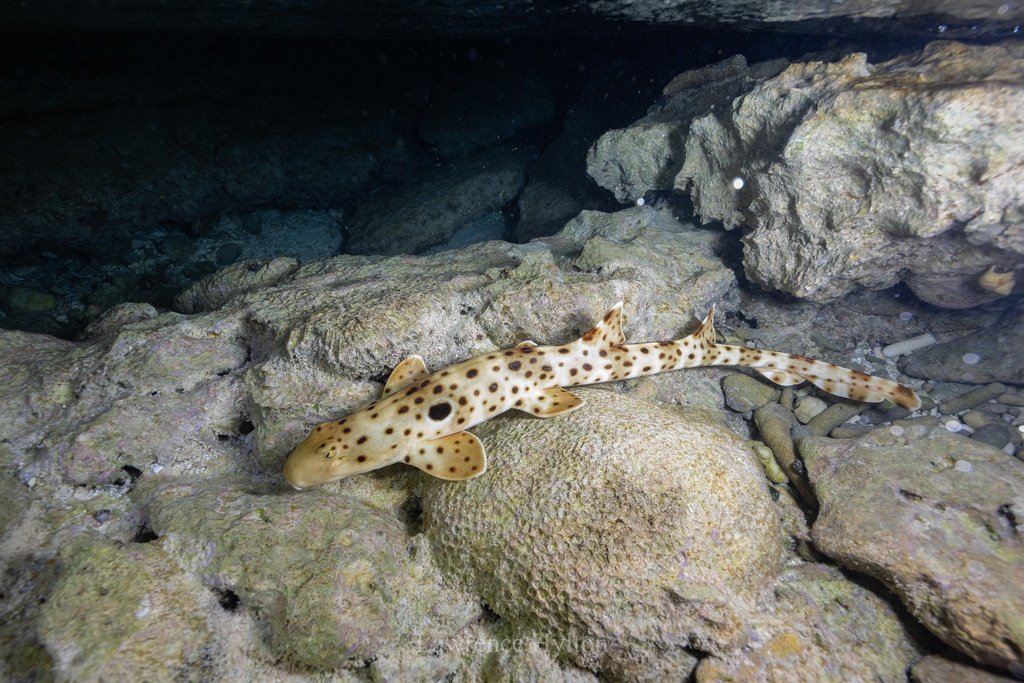
- Diet
- An opportunistic predator of benthic crustaceans, worms and small bony fishes.
- Size
- 70–90 cm
- Range
- Native to shallow tropical waters from southern New Guinea along northern Australia, south as far as Sydney.
- Habitat
- Shallow tropical coastal habitats, especially tidal pools, coral flats and staghorn-coral stands; recorded to 50 m depth.
- Activity
- Largely nocturnal and most active in low water; it often feeds at dawn and dusk.
- Reproduction
- Oviparous. Females deposit egg capsules in pairs, usually every 14 days from August to December, producing 20–50 eggs per year.
- Conservation
- Least Concern globally according to the IUCN assessment cited in the source; assessed as Near Threatened in New Guinea.
- Getting around
- Instead of relying only on swimming, this shark can “walk” across the seabed by wriggling its body and pushing with its broad pectoral and pelvic fins. The same movement can carry it out of the water between isolated tidal pools.
- Camouflage
- Its large, white-edged black spots sit just behind the pectoral fins and resemble shoulder decorations, giving the species its common name. Its brown, spotted body also helps it blend into reef surroundings.
- Remarkable adaptations
- When a tidal pool loses oxygen overnight, the shark can remain responsive under extremely low-oxygen conditions. It reduces the energy demand of some brain regions while maintaining functions needed to sense its surroundings.
- Finding food
- While searching the bottom, it may turn over debris or push its head into sand. It can draw prey into its mouth and expel sand through its gill slits, and its teeth can flatten into a crushing surface for hard-shelled prey.
- Life cycles
- Females release egg capsules two at a time, usually once every 14 days during the breeding season. Young sharks hatch after about 120–130 days at roughly 14–16 cm long.
Facts
- Instead of relying only on swimming, this shark can “walk” across the seabed by wriggling its body and pushing with its broad pectoral and pelvic fins. The same movement can carry it out of the water between isolated tidal pools.
- Its large, white-edged black spots sit just behind the pectoral fins and resemble shoulder decorations, giving the species its common name. Its brown, spotted body also helps it blend into reef surroundings.
- When a tidal pool loses oxygen overnight, the shark can remain responsive under extremely low-oxygen conditions. It reduces the energy demand of some brain regions while maintaining functions needed to sense its surroundings.
- While searching the bottom, it may turn over debris or push its head into sand. It can draw prey into its mouth and expel sand through its gill slits, and its teeth can flatten into a crushing surface for hard-shelled prey.
- Females release egg capsules two at a time, usually once every 14 days during the breeding season. Young sharks hatch after about 120–130 days at roughly 14–16 cm long.
Print and study the Epaulette Shark
This species is included in: