Goblin Shark
Mitsukurina owstoni
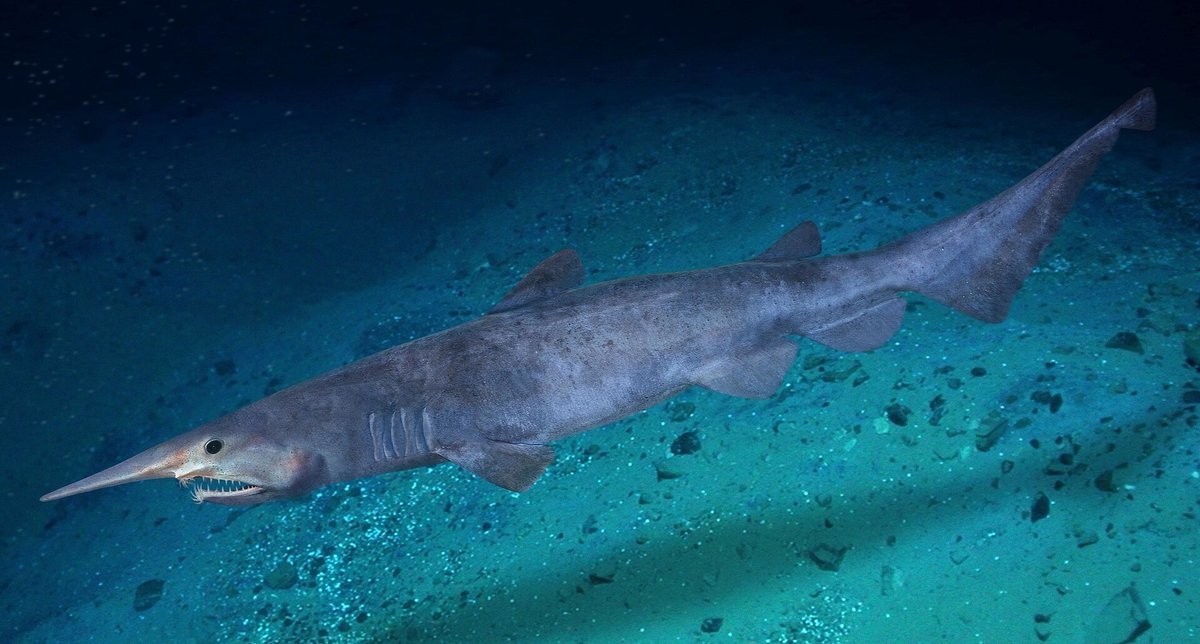
- Diet
- Feeds mainly on deep-sea fishes, and also takes cephalopods and crustaceans.
- Size
- 3–4 m
- Range
- Recorded in the Atlantic, Indo-Pacific and Oceania, and eastern Pacific oceans.
- Habitat
- A benthopelagic deep-sea shark of upper continental slopes, submarine canyons and seamounts, most often at 270–960 m; adults occur deeper than juveniles.
- Activity
- Anatomical features suggest a sluggish, slow-swimming lifestyle; it may ambush prey by drifting toward it with minimal movement.
- Reproduction
- Reproductive behavior is poorly understood, and mating has not been observed. A pregnant female carrying six pups was captured in Taiwan in 2023; the species likely has small litters and embryos that grow during gestation by eating undeveloped eggs.
- Conservation
- Least Concern (IUCN assessment); also classified in New Zealand in 2018 as “At Risk – Naturally Uncommon,” with the qualifiers “Data Poor” and “Secure Overseas.”
- Finding food
- Its jaws can shoot forward almost to the end of the snout. Elastic ligaments help catapult them outward, while the mouth floor drops to expand the oral cavity and draw in water and prey.
- Sensing the world
- The long snout is covered with ampullae of Lorenzini—sensory organs that detect the weak electric fields produced by nearby animals. This gives the shark a way to locate prey in the dim deep sea.
- What to notice
- Living goblin sharks are pink or tan because blood vessels show through their soft, semi-translucent skin. After death, the color quickly fades to dull gray or brown.
- Look closer
- The shark was formally described in 1898 from an immature male caught in Sagami Bay, Japan. Its scientific name honors shipmaster and naturalist Alan Owston and Professor Kakichi Mitsukuri.
- Remarkable adaptations
- Although observations are scarce, its low-density flesh and large oily liver make it neutrally buoyant. It can therefore drift toward prey with little movement before striking.
Facts
- Its jaws can shoot forward almost to the end of the snout. Elastic ligaments help catapult them outward, while the mouth floor drops to expand the oral cavity and draw in water and prey.
- The long snout is covered with ampullae of Lorenzini—sensory organs that detect the weak electric fields produced by nearby animals. This gives the shark a way to locate prey in the dim deep sea.
- Living goblin sharks are pink or tan because blood vessels show through their soft, semi-translucent skin. After death, the color quickly fades to dull gray or brown.
- The shark was formally described in 1898 from an immature male caught in Sagami Bay, Japan. Its scientific name honors shipmaster and naturalist Alan Owston and Professor Kakichi Mitsukuri.
- Although observations are scarce, its low-density flesh and large oily liver make it neutrally buoyant. It can therefore drift toward prey with little movement before striking.
Print and study the Goblin Shark
This species is included in: