Common Thresher Shark
Alopias vulpinus
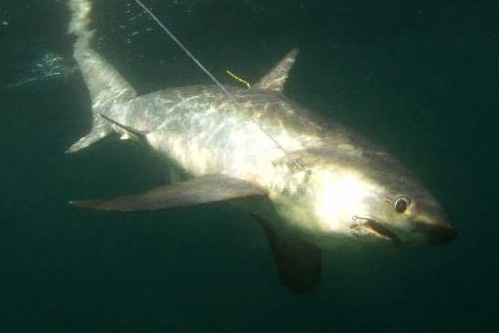
Original JPEG bytes retained; no additional crop, retouching or re-encoding.
Source title: Alopias vulpinus noaa2.jpg
- Diet
- Feeds mainly on small schooling fishes; also takes larger solitary fishes, squid and other pelagic invertebrates. [3]
- Range
- Worldwide in tropical and cold-temperate waters, including the Atlantic, Indo-Pacific and eastern Pacific. [3]
- Habitat
- Coastal–oceanic: found near shore and in the open ocean, from the surface to at least 550 m. [3]
- Lifespan
- Known to live at least 15 years; estimated maximum lifespan: 45–50 years [3]
- Activity
- Active, strong swimmer; seasonally migratory, moving toward higher latitudes with warm-water masses. It may leap completely out of the water. [3]
- Reproduction
- Aplacental viviparous; embryos feed on undeveloped eggs produced by the mother. Females typically give birth to four pups after a nine-month gestation, with litters otherwise reported as two to four pups in the eastern Pacific and three to seven in the eastern Atlantic. [3]
- Conservation
- Vulnerable; reassessed by the International Union for Conservation of Nature in 2007, with an amended assessment published in 2022. [3]
Facts
- Its enormous upper tail lobe is used like a whip to strike and incapacitate prey. Before a strike, threshers may circle a school of fish and splash with their tails, sometimes working in pairs or small groups. [3]
- The common thresher can maintain body temperatures above the surrounding seawater in some tissues. A specialized network of blood vessels helps generate and retain heat, while red swimming muscles average 2 °C warmer than the ambient water. [3]
- About half of the shark's total length is its elongated upper caudal-fin lobe. The white underside also extends over the bases of the pectoral fins, a useful field mark separating it from the similarly shaped pelagic thresher. [3]
- Developing young feed on unfertilized eggs released by their mother—a form of nourishment called oophagy. Newborn pups are usually 114–160 cm long and weigh 5–6 kg. [3]
- Juveniles often remain in warm nursery areas, while adults move seasonally toward higher latitudes. In the eastern Pacific, males travel farther north than females, reaching Vancouver Island in late summer and early fall. [3]
Field notes
Minimally dangerous to humans; it is described as shy and difficult to approach underwater, with one provoked attack and four likely incidental attacks on boats listed in the International Shark Attack File.
- Common thresher · Creative Commons Attribution-Share Alike 4.0 · Wikipedia contributors · Resolved by direct_scientific_title; article scope=species.
Research sources
- GBIF Backbone Taxonomy · Creative Commons Attribution 4.0 · GBIF Secretariat, GBIF Backbone Taxonomy · Used for taxonomic name resolution and higher classification only.
- Wikidata item Q57311184 · CC0 1.0 · Wikidata contributors · Used for exact species identity, standard-rank taxonomy normalization, conservation fallback when unambiguous, and the English Wikipedia sitelink.
- Common thresher · Creative Commons Attribution-Share Alike 4.0 · Wikipedia contributors · Resolved by direct_scientific_title; article scope=species.