Whale Shark
Rhincodon typus
- Diet
- An active filter feeder that consumes plankton, krill, fish eggs, jellyfish, small squid and small schooling fish.
- Size
- Up to 18.8 m
- Range
- Tropical and warm-temperate seas worldwide; highly migratory.
- Habitat
- Primarily pelagic, occupying both coastal and oceanic waters; usually found where water temperatures exceed 21 °C.
- Lifespan
- Estimated at 80–130 years
- Activity
- Highly migratory; travels long distances to exploit seasonal food sources and may alternate surface swimming with deep dives.
- Reproduction
- Ovoviviparous: eggs remain inside the female and hatch there before live young are born. A pregnant female was reported carrying about 300 pups, and pups are 40–60 cm long at birth.
- Conservation
- Endangered on the IUCN Red List; the global population has declined by more than 50% over the last 75 years.
- What to notice
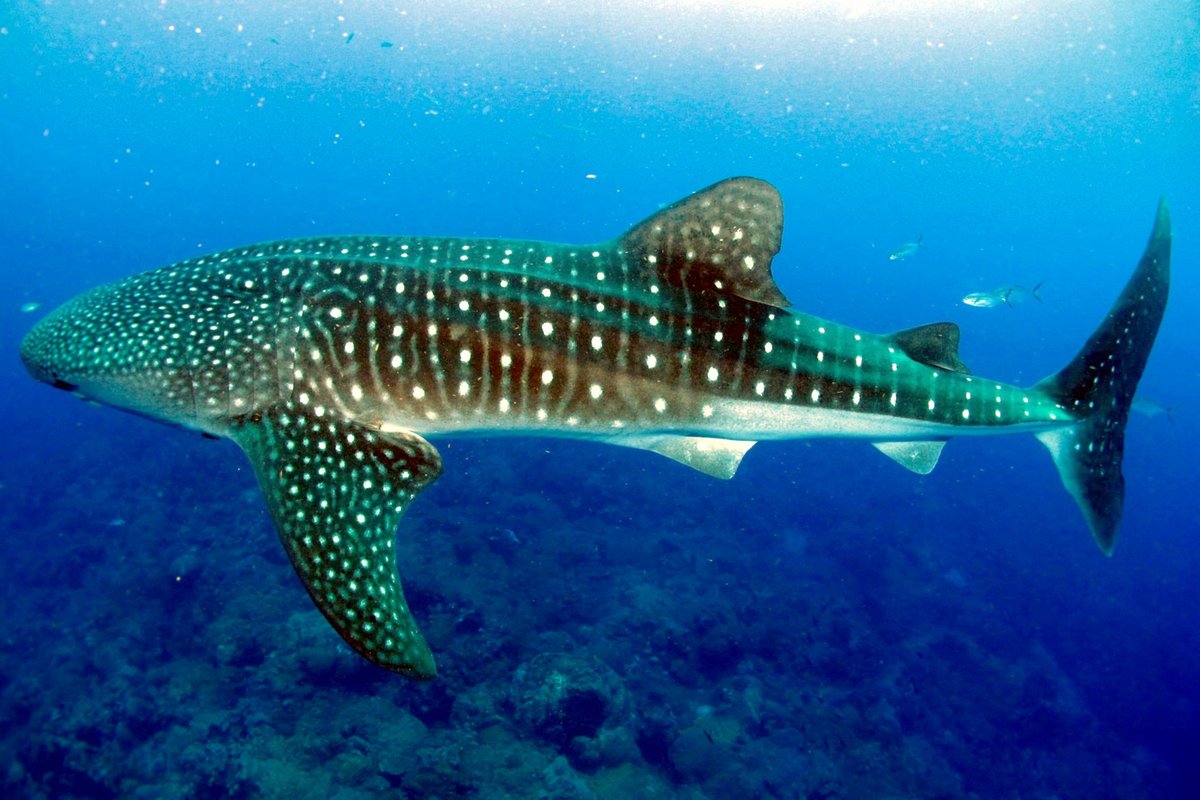
- Each whale shark has its own arrangement of pale spots and stripes against its dark grey back. Researchers can use this pattern like a natural identification mark to recognize individuals.
- Finding food
- Instead of biting large prey, it strains food from water through specialized sieve-like gill pads. It can feed while swimming forward or by gulping water while nearly stationary, and has been seen coughing to clear particles from the pads.
- Seasonal journeys
- Whale sharks make long journeys between feeding areas, including seasonal coastal gatherings. One tracked pregnant female traveled 7,772 km in 150 days, with repeated deep dives during the journey.
- Life cycles
- A pregnant female was found carrying about 300 pups. The young are born live at 40–60 cm long, and evidence suggests they may be delivered gradually rather than all at once.
- Remarkable adaptations
- The whale shark can dive far below the surface: the deepest recorded dive reached 1,928 m. It may also remain below 50 m for three days or more.
Facts
- Each whale shark has its own arrangement of pale spots and stripes against its dark grey back. Researchers can use this pattern like a natural identification mark to recognize individuals.
- Instead of biting large prey, it strains food from water through specialized sieve-like gill pads. It can feed while swimming forward or by gulping water while nearly stationary, and has been seen coughing to clear particles from the pads.
- Whale sharks make long journeys between feeding areas, including seasonal coastal gatherings. One tracked pregnant female traveled 7,772 km in 150 days, with repeated deep dives during the journey.
- A pregnant female was found carrying about 300 pups. The young are born live at 40–60 cm long, and evidence suggests they may be delivered gradually rather than all at once.
- The whale shark can dive far below the surface: the deepest recorded dive reached 1,928 m. It may also remain below 50 m for three days or more.
Print and study the Whale Shark
This species is included in: