Bowmouth Guitarfish
Rhina ancylostoma
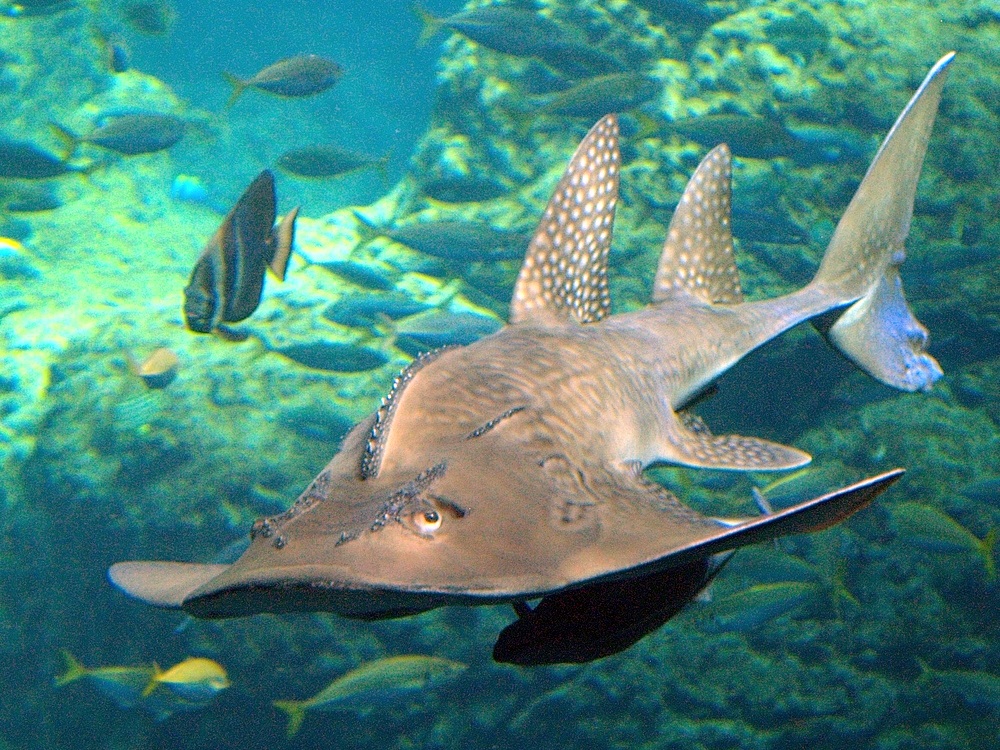
Existing source derivative: color correction and crop by Yzx from the OpenCage photograph. Original derivative JPEG bytes retained; no additional changes.
Source title: Rhina ancylostoma-2.jpg
- Diet
- A strong-swimming predator that feeds mainly on demersal bony fishes and crustaceans; it also consumes bivalves and cephalopods. [3]
- Range
- Widely distributed in tropical coastal waters of the western Indo-Pacific, from KwaZulu-Natal and the Red Sea across the Indian Ocean and Southeast Asia to Western Australia; its Pacific range extends to Korea, southern Japan, New Guinea and New South Wales. [3]
- Habitat
- Usually near the sea floor at depths from 3 to 90 m, especially over sandy or muddy bottoms near rocky reefs, coral reefs and shipwrecks; it can occasionally swim in midwater. [3]
- Lifespan
- One individual lived for seven years in captivity. [3]
- Activity
- More active at night; usually near the sea floor but occasionally seen swimming in midwater. It is not known to be territorial. [3]
- Reproduction
- Viviparous, giving birth to litters of two to eleven pups. Developing embryos are sustained to term by yolk; newborns measure 45–51 cm long. [3]
- Conservation
- Critically Endangered globally, assessed by the IUCN in 2019; Near Threatened in the Australian regional assessment. [3]
Facts
- Its mouth forms a distinctive W-shaped line, while white spots and black markings above the pectoral fins create a bold pattern across its broad, thick body. [3]
- Unlike many rays that move mainly with their broad fins, this species drives itself with its tail in a shark-like style. Its tail is longer than its body and ends in a large crescent-shaped fin. [3]
- Rows of flattened, ridged teeth help it crush hard-shelled prey such as crabs, shrimp and bivalves. [3]
- Females give birth to live young rather than laying eggs. Litters contain two to eleven pups, each already measuring 45–51 cm at birth. [3]
- Its head and back carry several thorn-bearing ridges, including a heavy central ridge along the back. These structures help protect the ray, which may also ram a perceived threat. [3]
Field notes
Sharp, robust thorns cover ridges on the head and back. When threatened, the ray may ram; its rough, thorny skin also makes it difficult to handle when caught.
- Rhina ancylostoma · Creative Commons Attribution-Share Alike 4.0 · Wikipedia contributors · Resolved by direct_scientific_title; article scope=species.
Research sources
- GBIF Backbone Taxonomy · Creative Commons Attribution 4.0 · GBIF Secretariat, GBIF Backbone Taxonomy · Used for taxonomic name resolution and higher classification only.
- Wikidata item Q106376698 · CC0 1.0 · Wikidata contributors · Used for exact species identity, standard-rank taxonomy normalization, conservation fallback when unambiguous, and the English Wikipedia sitelink.
- Rhina ancylostoma · Creative Commons Attribution-Share Alike 4.0 · Wikipedia contributors · Resolved by direct_scientific_title; article scope=species.