Blacktip Reef Shark
Carcharhinus melanopterus
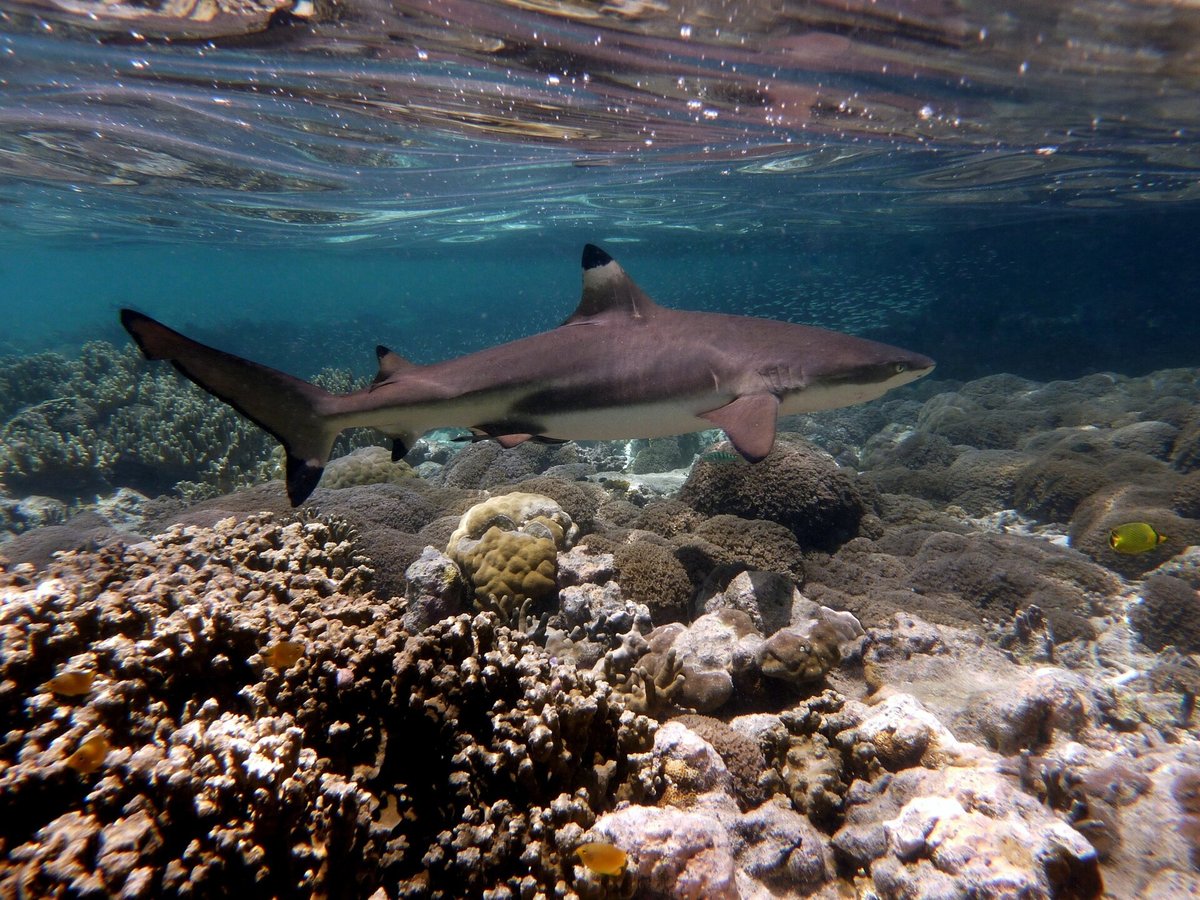
- Diet
- An active predator of small bony fishes, cephalopods and crustaceans; it also takes sea snakes, seabirds, carrion, and smaller sharks and rays.
- Size
- 1.6 m
- Range
- Tropical and subtropical nearshore waters of the Indo-Pacific, with an introduced population in the eastern Mediterranean Sea.
- Habitat
- Usually inhabits shallow inshore water around coral reefs, reef ledges and sandy flats; it may also enter mangroves, estuaries, brackish water and some freshwater environments.
- Activity
- Fast-swimming and active, it may be encountered alone, in small groups or in larger aggregations. Feeding activity may be greater at night than during the day, and individuals often patrol reef ledges with short forays onto sandy flats.
- Reproduction
- Viviparous females give birth to 2–5 young, typically 4. Reproductive timing varies by region from annual to biennial or possibly twice-yearly cycles; reported gestation periods also vary geographically.
- Conservation
- Vulnerable; declining according to the IUCN assessment cited in the source (2020).
- What to notice
- The species is easy to recognize in clear water by the strong black tips on its fins, especially the first dorsal fin and the lower lobe of the tail, set off by lighter borders.
- Getting around
- Blacktip reef sharks can have remarkably small home ranges. Tracking at Palmyra Atoll found a home range of around 0.55 km, and individuals may remain in the same local area for several years.
- Finding food
- In the Indian Ocean, groups have been observed herding schools of mullet against the shore, concentrating the fish before feeding.
- Raising the next generation
- Newborn sharks use very shallow nursery areas close to shore. During high tide, they may move over flooded coral platforms or seaweed beds, and young sharks often gather in large groups over sand flats or in mangrove swamps.
- Life cycles
- A female's reproductive schedule can differ with location: the source reports annual cycles in northern Australia and Moorea, but a biennial cycle at Aldabra, where competition for food may constrain how often females bear young.
Facts
- The species is easy to recognize in clear water by the strong black tips on its fins, especially the first dorsal fin and the lower lobe of the tail, set off by lighter borders.
- Blacktip reef sharks can have remarkably small home ranges. Tracking at Palmyra Atoll found a home range of around 0.55 km, and individuals may remain in the same local area for several years.
- In the Indian Ocean, groups have been observed herding schools of mullet against the shore, concentrating the fish before feeding.
- Newborn sharks use very shallow nursery areas close to shore. During high tide, they may move over flooded coral platforms or seaweed beds, and young sharks often gather in large groups over sand flats or in mangrove swamps.
- A female's reproductive schedule can differ with location: the source reports annual cycles in northern Australia and Moorea, but a biennial cycle at Aldabra, where competition for food may constrain how often females bear young.
Print and study the Blacktip Reef Shark
This species is included in: