Largetooth Sawfish
Pristis pristis
- Diet
- A predator that feeds on fish, molluscs and crustaceans.
- Range
- Historically widespread in tropical and subtropical coastal waters worldwide, with freshwater populations and river records far inland; it has disappeared from much of its historical range.
- Habitat
- Adults are primarily found in estuaries and shallow marine waters, but the species also enters rivers and lakes. It is generally associated with sandy, muddy or silty bottoms.
- Lifespan
- Potential lifespan is unknown; four estimates suggested 30, 35, 44 and 80 years.
- Reproduction
- Breeding is seasonal, though timing varies by region. This ovoviviparous species has a gestation period of about five months; females may breed every 1–2 years and produce 1–13 young, which are born near river mouths and commonly spend their first 3–5 years in freshwater.
- Conservation
- Critically Endangered (IUCN assessment cited in the supplied source, 2022).
- What to notice
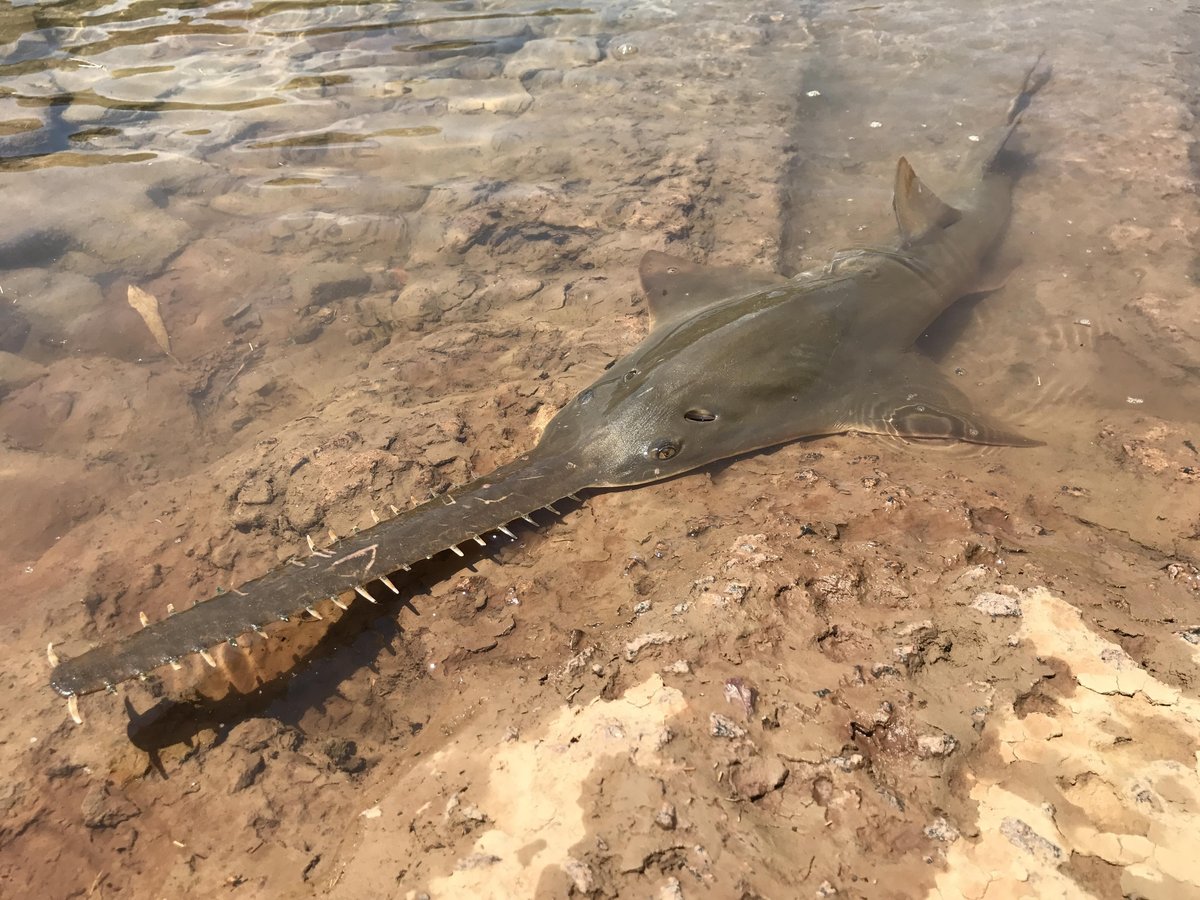
- Look for a dorsal fin set clearly ahead of the pelvic fins, a small lower tail lobe and angular-tipped pectoral fins. Its broad saw bears 14–24 teeth on each side.
- Finding food
- The saw is more than a striking profile: the fish can stir the bottom with it to uncover prey or slash through groups of fish.
- Getting around
- Although it is a marine fish, it can travel deep into river systems; records place it as far as 1,340 km from the sea.
- Life cycles
- Young are typically born in salt or brackish water near river mouths, then move into freshwater, where they may spend their first 3–5 years.
- Conservation stories
- The species has vanished from much of its former range: of 75 countries with historical records, it has disappeared from 28 and may be gone from another 27.
Facts
- Look for a dorsal fin set clearly ahead of the pelvic fins, a small lower tail lobe and angular-tipped pectoral fins. Its broad saw bears 14–24 teeth on each side.
- The saw is more than a striking profile: the fish can stir the bottom with it to uncover prey or slash through groups of fish.
- Although it is a marine fish, it can travel deep into river systems; records place it as far as 1,340 km from the sea.
- Young are typically born in salt or brackish water near river mouths, then move into freshwater, where they may spend their first 3–5 years.
- The species has vanished from much of its former range: of 75 countries with historical records, it has disappeared from 28 and may be gone from another 27.
Print and study the Largetooth Sawfish
This species is included in: